


Two days before Election Day, Adam Green, a co-founder of the Progressive Change Campaign Committee, had already picked out the candidate who’s going to prove his group right. “For us, Abdul is Exhibit A,” Green told Politico in a story published Sunday, meaning Abdul El-Sayed, the Democrat running for Senate in Michigan.
Exhibit A for the theory the Progressive Change Campaign Committee has spent this cycle trying to prove: that Democrats can win just about anywhere if they run populists who go after big corporations. Politico also got a look at a draft of the group’s post-election memo, which predicts that this year’s winners will turn out to be, well, outsiders and economic populists.
The moderates have their paperwork ready, too. The same story describes a Blue Dog PAC memo about how well its candidates are doing in races Republicans were supposed to win easily. There’s also one from the Bench, which wants Democrats to recruit people with careers outside of politics, saying that candidates like James Talarico, the Democrat running for Senate in Texas, are making its case for it.
Matt Bennett, a co-founder of the centrist group Third Way, told Politico that the fight over what the results mean had already started, and then he took a shot of his own, saying progressives would overstate whatever wins they get and use them to push the party left. (Because we all know that Third Way would never wink wink overstate their preferred candidates’ wins as an exuse to try to push Democrats to the right…)
Partisans and commentators are incentivized to instantly claim that the election results actually prove that their own beliefs are correct. We see this all the time. People providing this sort of analysis almost always have an ulterior motive. And they do it for good reason: it works.
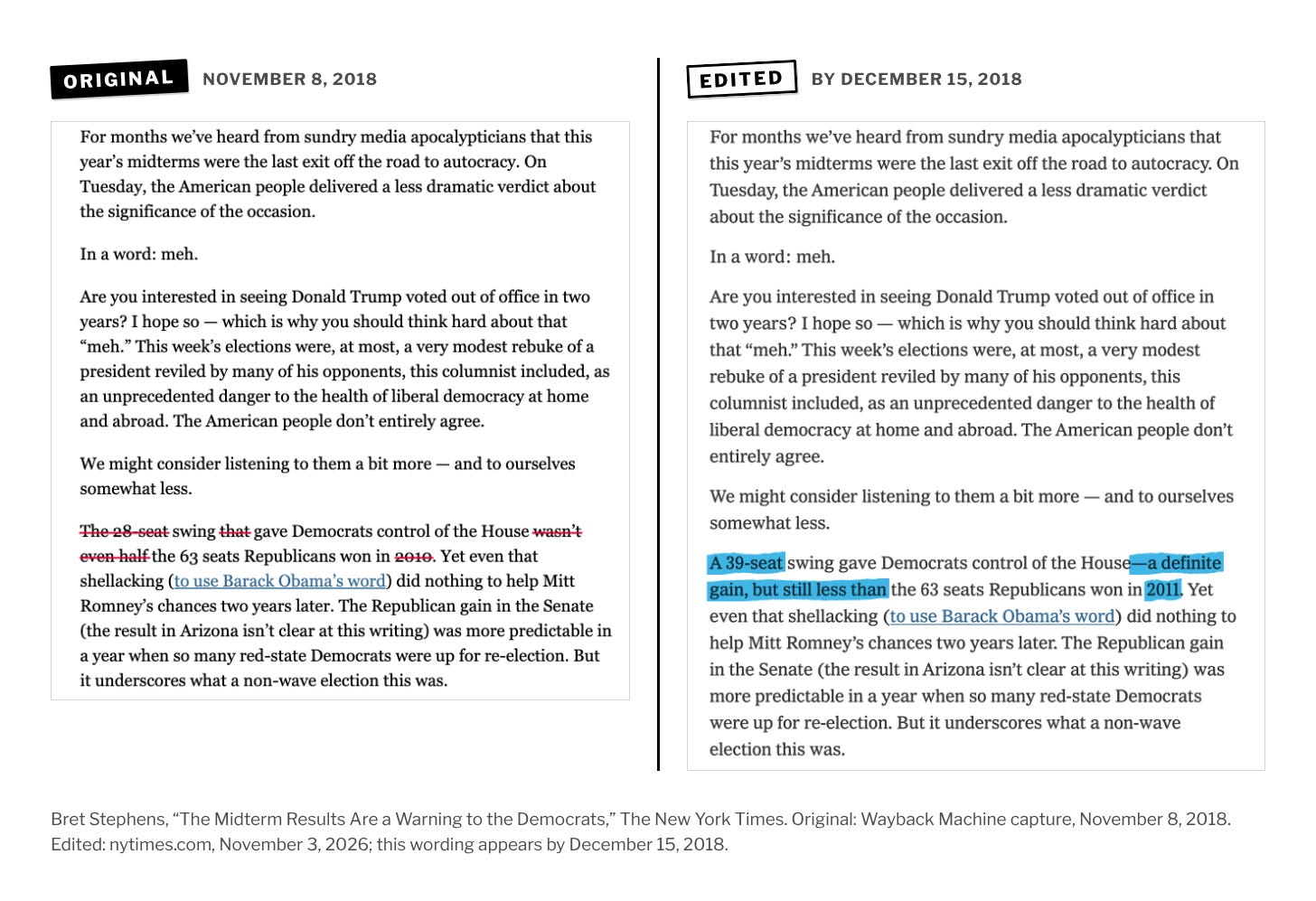
Bret Stephens’ November 2018 column for the New York Times is the best example I know of how foolish and predetermined a lot of these takes are.
How do you update a column without updating the argument?
The column ran on November 8, 2018, two days after Democrats took back the House, under the headline “The Midterm Results Are a Warning to the Democrats.” Stephens’ review of the election: “In a word: meh.”
The first version had Democrats picking up 28 House seats, which he pointed out was less than half of what the GOP picked up in 2010. Throw in the Republican gains in the Senate, and this was no wave, as far as he was concerned. From there, the column is mostly Stephens going “and another thing” about the progressives Democrats nominated in Florida and Georgia, the money that went to Beto O’Rourke, how much attention Democrats paid to Trump’s taxes and, at considerable length, the Kavanaugh fight. Democrats, he concluded, needed to get humble and stop sneering at Trump voters, or Trump would be the favorite in 2020.
Votes were still being counted, of course. That evening, Nate Silver tweeted that Stephens surely knew “how dumb his hot take was,” noting that FiveThirtyEight now had Democrats on track for a gain of around 37. Stephens fired back that night at Silver and Soledad O’Brien, in a tweet that’s no longer up but that Jeet Heer embedded in a piece for The New Republic. He brought up the Senate, and the much bigger Republican waves of 1994 and 2010, and wrapped up with this: “My point stands. My advice is worth heeding.” Then he called them trolls.


He’d been making some version of this argument for weeks. The late, great Simon Maloy pointed out in a piece for Media Matters at the end of November that on October 12, Stephens had published a column headlined “Democrats Are Blowing It, Again.”
Maloy also noticed that the column itself had changed. The 28 held for about a week. If you’d opened it around Thanksgiving, you’d have found a new number, 37, and a gentler comparison to the Republican wave of 2010, which the column now said happened in 2011, along with a one-line note at the bottom saying the numbers had changed, with no mention of what they’d been. By mid-December it said 39, and it still does. Democrats netted 40.
The rest reads the same as it did on November 8. Same “meh,” same no-wave verdict, same warning about 2020. There’s also an aside about Arizona’s Senate race being too early to call, written in the present tense, and it’s still in the present tense. The Associated Press called that race for Kyrsten Sinema on November 12, 2018, so it certainly could have been updated along with the other numbers, but wasn’t.
Win or lose, the advice is the same
Conservatives will always argue that Democrats need to move to the right, saying that’ll help them win. And progressives will always argue that Democrats need to move to the left. Every faction’s version is basically “see, [whatever kind of Democrat we were already pushing] won, so obviously the party needs more of those.” And if Democrats lose? Well, that’s because they didn’t run enough of them.
The party’s centrists have been at this a while. Third Way’s election-night statement in 2018, issued by the same Matt Bennett, credited the blue wave to the party’s big tent and the “mainstream candidates” voters rewarded. After Kamala Harris lost in 2024, the political analyst Ruy Teixeira argued that Democrats “lost in no small part because of cultural issues.” And Third Way’s takeaway from last year’s Democratic wins: if the party wants to win competitive races in 2026 and 2028, it needs “candidates who can be credibly called mainstream.”
And progressives draw the opposite lesson every time. The day after Trump won, Sen. Bernie Sanders (I-VT) said the Democratic Party had “abandoned working class people.” When Zohran Mamdani won the New York City mayor’s race a year later, he told the crowd that if the night proved anything, it was that “convention has held us back,” and Justice Democrats said his win “should put every single entrenched, corporate Democrat on notice.”
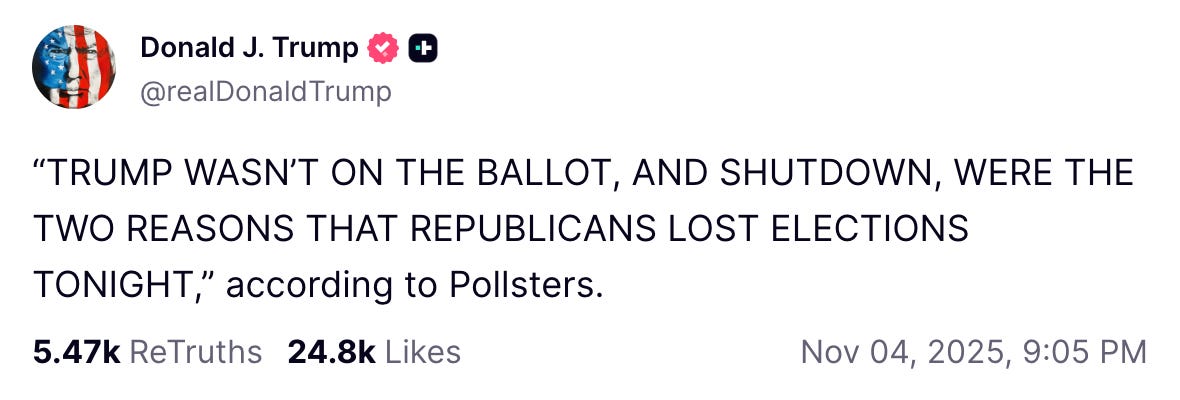
Trump’s fix never changes either. On election night last year, as Republicans were losing badly, he posted that “TRUMP WASN’T ON THE BALLOT, AND SHUTDOWN, WERE THE TWO REASONS” they lost (citing unnamed pollsters), and within the hour he was back to calling for voter ID and an end to mail-in ballots. He’d been on that since at least February 2025, according to a list of examples Glenn Kessler compiled last month of Trump saying Democrats can only win by cheating.
Why the rush? Back in 1992, the political scientist Marjorie Randon Hershey studied how newspapers explained Reagan’s 1984 landslide, and her argument was that the explanations get “winnowed to a relative few, which then become ‘conventional wisdom.’” (Seth Masket later summarized her counts: more than 80 explanations in the first few weeks, about 10 two months later.) If you want yours to be one of the 10, you can’t exactly wait around for the final count.
Remember who got blamed last time?
The day after the 2024 election, Rep. Tom Suozzi (D-NY) told the New York Times that his party had to stop catering to the far left and, after saying he didn’t want to discriminate against anyone, added, “I don’t think biological boys should be playing in girls’ sports.” Rep. Seth Moulton (D-MA) made the same complaint to the Times the next day. NBC News rounded up both comments that week.
One poll came out the same day as Moulton’s comments and another three weeks after that, both from people with a stake in the answer. The Human Rights Campaign’s poll said the anti-trans ads hadn’t moved voters. Then the American Principles Project, which runs anti-trans ads of its own, put out its poll, and its president, Terry Schilling, declared, “The evidence is now incontrovertible: the culture war is a winner for Republicans.”
A year later, Winsome Earle-Sears ran for governor of Virginia on so many anti-trans ads that James Blair, a deputy chief of staff in Trump’s White House, said more than half of them were about trans issues, which he noted voters didn’t even rank in their top five. She lost by almost 15 points. Schilling’s take? “There were no surprises Tuesday night.” Virginia, New Jersey and New York were blue states, he said, and the Democrats running for governor had dodged the trans issue anyway. He hoped they’d keep refusing to moderate on it so Republicans could pick up more seats in 2026. So when Democrats lost in 2024, it was because of trans people, and when they won in 2025, it was because they didn’t talk about trans people. Either way, the lesson is about trans people.
True or not, the day-after version is the one that stuck. Two years later, and people seem to have just accepted that immediate propaganda push as fact. Gov. Gavin Newsom (D-CA) had Charlie Kirk on his podcast last year and told him that on trans girls in sports: “We’re getting crushed on it. Crushed. Crushed.” Virginia didn’t change much. Last month, Axios described the 2024 loss as something “many in the party attributed to being outflanked by GOP messaging on trans issues.” And Democrats like Rep. Marcy Kaptur (D-OH) and Josh Turek, the party’s Senate candidate in Iowa, have taken up anti-trans messaging themselves this year.
On the other side, Rep. Sarah McBride (D-DE) called Virginia a “clear repudiation of a cynical political strategy.” And tonight, I’m sure you’ll see people who are pro-trans do the same thing, pointing to any pro-trans Democrats who win as proof that Democrats need to be pro-trans.
LGBTQ Nation has already predicted that if Democrats come up short, it’ll take “about 60 seconds” for the blame to land on trans people. Hell, even if Democrats win, centrists might still sneer at trans people like Claire McCaskill did in 2020 when she blamed trans people for losses (in an election that Democrats won). So yeah, that sounds about right to me.
Anyway, my point in all of this is that I really hope people understand that you’re going to see and hear a lot of stuff about how Tuesday’s results, whatever they may be, prove that commentators', pundits ', and activists’ own beliefs are the one true takeaway from the night. Take that analysis with a grain of salt.
The key seems to be to have someone to vote AGAINST, based on how negative campaigning has gotten cause of money, how little people pay attention until something breaks through, and how terribly out of touch the consulting class is. If you can hang a bad actor around the other party, you will win. It has to be a person or something you can explain in 5 words or less to the low-info types. Then you have to pound that message like rivets on a skyscraper over and over and over to break into the consciousness. TLDR democracy, as we are practicing it, is pretty terrible.
Another day, another great post. Thanks, Parker. It baffles me that people don't see through this and it infuriates me that so many "liberals" and "progressives" are perfectly content underbussing the trans community (and often the rest of the LGBQ community) whenever expedient. I'm absolutely looking at Haley Stevens, among many others.