


There’s a new study out about X’s feed algorithm, published Monday in the Proceedings of the National Academy of Sciences by a Stanford-led team. Matthew Gault over at 404 Media has a really good write-up about it, but the tl;dr is that X’s algorithm fills people’s “For You” feed with stuff that will make you mad, on the theory that anything you can’t stop looking at must be something you want. The paper calls this a value misalignment between users and their feeds.
And, I guess… just… duh. Obviously.
“Engagement is easy to measure, so the platforms use it as the primary metric to assess user interest in the content,” said paper co-author Ziv Epstein in a press release published by Stanford. “They are saying, in effect, engagement equals values, but it’s not that simple.”
And yes, Elon Musk is almost certainly doing things with the X algorithm to try to push the public towards his views. The pushing part is just a fact: an experiment published in Nature in February put nearly 5,000 people on either the “For You” algorithmic feed or the reverse-chronological one of just the accounts they followed for seven weeks. Those on the algorithmic feed drifted rightward on policy priorities, on Trump’s prosecutions, on Ukraine, and other issues. That same feed also ran 58% fewer posts from actual news organizations. Yikes!
But as it turns out, some of this is on us, too, and on how we interact on social media.
“The message we take away is that the values that we hold – what we really care about – should be just as informative to the platforms as engagement,” paper co-author Michael Bernstein said. “Right now, we engage with all sorts of content – sometimes because we agree with it, and sometimes because we’re angry at it – but the platforms misinterpret it all as a kind of desire for more of that kind of content.”
This got me thinking about how much of my own feed I’ve built by hand, one angry reply at a time.

Who are these replies even for?
A week or two ago, on Threads, I replied to an anti-trans post about the WNBA.
I knew better. I have known better for years. But it was one of those posts about women’s basketball being under siege from a trans player, and I did the thing I always do, which is write something back saying that trans people actually had nothing to do with the manufactured outrage being stoked by the right.
And then my feed was that. Just that. Only that. Literally nothing but posts about how trans people are ruining the WNBA, bathrooms, sports, and locker rooms.
For days I opened the app to a flood of people I’d never seen before explaining that people like me are “men.” There wasn’t much actually about sports policy. Mostly misgendering, AI-generated slop images of burly men with pigtails dunking on women, over and over, in a scroll-friendly format. It was the most miserable my phone has been in a bit, and I did it to myself. (There has never been a trans woman in the WNBA. Fox News has spent more than thirteen hours on the league since late June anyway, hours of it on trans athletes. I hate being at the center of a culture war! I’ll probably write something about all this soon.)
In any case, between my experience on Threads and this story about the X algorithm, I’ve been thinking a little bit about who I’m replying to and why I’m doing it. I’ve always kind of thought of my replies as not being for the benefit of the post’s author, but for others reading the comments. But isn’t that a little silly? It’s been like 15 years of this stuff. Have replies to posts about things that I disagree with actually changed anything in this world? Doubtful.
What I have done is told these various social algorithms to feed me more nonsense that enrages me, that this content is good and should be promoted into more people’s feeds. I’m basically helping to spread a virus.
Knowing all of this has not stopped me and probably won’t
“Don’t feed the trolls“ is old-school social media advice, and contested advice at that, for reasons mostly having to do with the fact that harassers don’t actually stop when you ignore them. Well-meaning people have given me this advice hundreds of times, and I’ve given it to others a hundred more. Why is it that I can’t just… do it?
I think some of it has to do with the fact that ignoring, muting, and blocking are invisible actions. And scrolling past ragebait can feel weirdly like conceding the point or argument. Replying is the only thing that actually feels like doing something, even if what I’m doing is ultimately unproductive.
I do find it a lot easier to ignore posts I disagree with when they have to do with topics I’m not super passionate about. Like, oh, cool, you didn’t like The Odyssey? Neat. No biggie. But it’s a much harder sell when the person you’re tempted to reply to is saying something about whether people like me should be allowed to use public restrooms, get called by the names we want to be called, and protected from discrimination. And it’s harder still when I can see that most of the replies agree with the original post. Letting it go is difficult, so I don’t let it go.
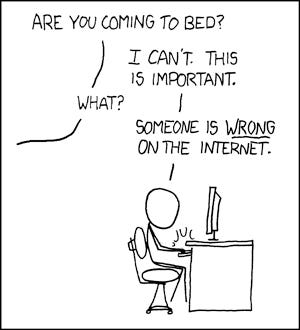
I’m going to make a point of trying to reply to things I actually want more of on the internet, and of not handing those replies to people whose entire job is winding me up. I doubt I’ll be any good at it.
Why anyone remains on Twitter or any of the Meta products is a mystery to me. Obviously if you have a business or are a journalist like Parker I guess you have to, but I have been off Twitter since the day he bought it and FB/Insta since Zuckerberg was on stage at the inauguration, and I’ve literally NEVER regretted my decisions. BlueSky, Mastodon, and Substack are all the ‘interactivity’ I need!
I quit using Facebook years ago because of its infuriating control over what it would show me. "More of the same": not interesting to me.