

On Monday morning, CBS News published a story about Democratic nominee for U.S. Senate from Michigan Abdul El-Sayed headlined, “For Michigan Democrat Abdul El-Sayed, Sept. 11 commemoration invites scrutiny of past remarks,” and pushed the opening line out on X:
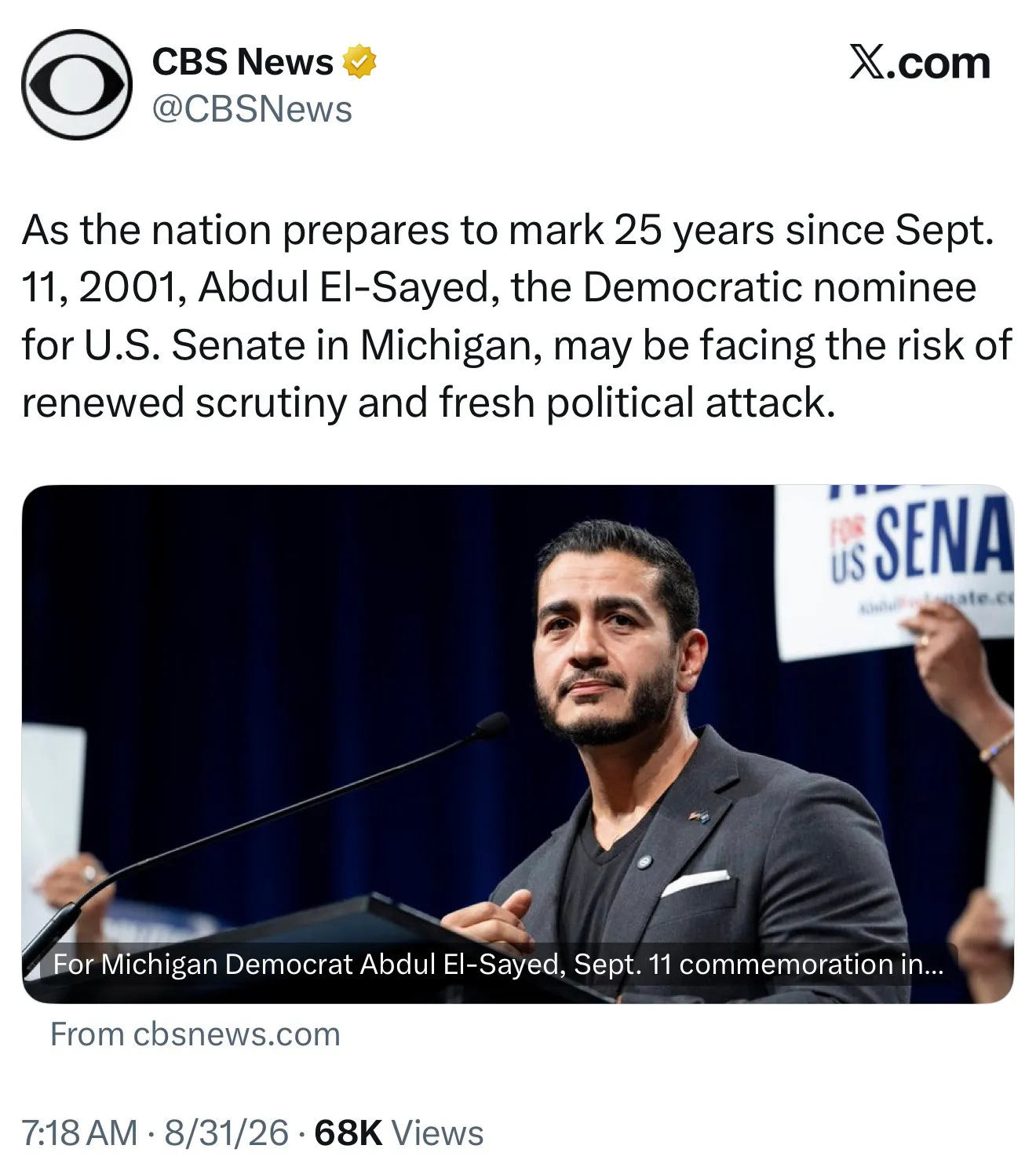
Now, you may be asking what El-Sayed, who was a high schooler at the time, has to do with 9/11. Here’s what the article gives us:
In an April 2020 tweet, El-Sayed “compared the nearly 3,000 Americans killed on Sept. 11 to the mounting COVID-19 death toll and argued for a response commensurate with the nation’s post-9/11 mobilization.”
Another COVID-related tweet: “El-Sayed wrote that because more Americans had died from COVID than in the Sept. 11 attacks, he hoped ‘that means we’ll spend the next ten years fighting a war for public health & against poverty … like we launched a global #WaronTerror after 9/11. We could save lives rather than take them.’”
In a tweet posted on September 11, 2021, marking the 20th anniversary of the 9/11 attacks, El-Sayed wrote, “Today, I mourn the 3K lives, 6K injuries, & infrastructural devastation in NYC, perpetuated ignorantly in the name of my faith. Tomorrow, I’ll mourn ~1M lives, millions of injuries, & infrastructural devastation in 3 countries, perpetuated ignorantly in the name of my country.”
Now, if you’re like me, you’re probably thinking, “Okay, and…?” Those are all perfectly reasonable statements. Yes, the fact that the U.S. was experiencing the equivalent of multiple 9/11s per week at certain points in the pandemic was pretty widely acknowledged. And hey, maybe it would have been nice if we’d have responded to pandemic deaths with the same urgency as we did the 9/11 attacks (but by addressing global health vs. starting what became not-so-lovingly referred to as “forever wars”). And the other comment there acknowledged the devastation of both the 9/11 terrorist attacks and the decades of destruction the U.S. waged on the Middle East in response. There’s absolutely nothing offensive or dismissive about acknowledging that, and the fact that this is at all controversial goes to show just how we’ve really failed as a country to learn any lessons from our disastrous start to the century.
The article was tagged “First on CBS,” but the piece pulls pretty heavily from a December 2025 article from the right-wing Washington Free Beacon, which tried (and failed) to whip up a scandal over the “Today, I mourn…” tweet.
Naturally, the National Republican Senatorial Committee sent out a press release with the CBS News story, celebrating it.
By early afternoon, CBS had tweaked the headline to focus specifically on the tweets (”Michigan Democrat Abdul El-Sayed’s deleted tweets on Sept. 11 attacks invite scrutiny of past remarks”), but the story had already served its purpose of trying to make it sound as though El-Sayed, who is Muslim, was at best ambivalent about the 9/11 attacks.
Everyone made the same comparison in 2020, including CBS News
On April 1, 2020, three weeks before El-Sayed’s tweet that “argued for a response commensurate with the nation’s post-9/11 mobilization,” CBS News political reporter Grace Segers published a story about Rep. Bennie Thompson (D-MS)’s call to create a bipartisan commission to look into the government response, modeled after the 9/11 commission.
“More Americans have now died from COVID-19 than were killed in the 9/11 attacks,” reads the second sentence of the story. Oh wow! How offensive to note this reality, I guess?
And it’s an obvious comparison to make. On Fox News, Neil Cavuto made it, saying “Yesterday, we had a record number of deaths in this country, more than died on 9/11.” Trump’s hand-picked Surgeon General Jerome Adams said that the COVID pandemic “is going to be our Pearl Harbor moment, our 9/11 moment,” adding, “Only, it’s not going to be localized, it’s going to be happening all over the country. And I want America to understand that.” In May 2020, Donald Trump himself said that the virus was “worse than Pearl Harbor. This is worse than the World Trade Center.”
I don’t think there were many people who looked at those statements and went after Cavuto, Adams, or Trump for supposedly not showing enough respect for the lives lost on 9/11 or anything like that. Why? Well, for one, because these aren’t disrespectful things to say! Just as there was nothing disrespectful in El-Sayed’s tweets.
The truth is that COVID was a big deal. I get that it’s currently in fashion to pretend that, if anything, we took it too seriously, but it’s just not true. Nearly a million Americans died from COVID in the first two years of the pandemic; the total is now more than 1.2 million. It was the deadliest pandemic in American history. At the very worst of it, more than 4,000 Americans died from COVID in a single day, surpassing the 9/11 death toll of 2,977 victims. We did not mobilize. We did not rebuild. We did not do the work to make sure the next pandemic would hurt us less. Yes, Operation Warp Speed helped get us a vaccine, but it was then undermined by Trump and Fox News once Biden won the 2020 election. We argued about masks. We complained about “lockdowns.” And then we mostly stopped talking about COVID at all. Now, if it comes up, it’s usually in the context of someone arguing we did too much during the pandemic, or rehashing the virus’ origins.
COVID was a global tragedy, yes; it was also a national tragedy. And if it was a national tragedy when three thousand Americans died on 9/11 — and it was — you really don’t get to shrug at the fact that 1.2 million people died from a pandemic that could have been much better handled.
“Tomorrow, I’ll mourn”
The other deleted post, the one the Free Beacon dug up in December, was posted by El-Sayed on September 11, 2021:
Today, I mourn the 3K lives, 6K injuries, & infrastructural devastation in NYC, perpetuated ignorantly in the name of my faith.
Tomorrow, I’ll mourn ~1M lives, millions of injuries, & infrastructural devastation in 3 countries, perpetuated ignorantly in the name of my country.
Again, I do not understand the objection here. Here he was, lamenting actions that were taken in his faith (Islam) and his country (the U.S.). The objection people seemed to have is basically that whatever you make of the sentiment, you don’t say it on 9/11. But 1.) that’s a pretty arbitrary rule that doesn’t actually make a ton of sense, and 2.) he specifically said that “today” was for mourning the victims of the terrorist attacks and “tomorrow” was for mourning everyone else.
It’s not in any way disrespectful to reflect on the serious mistakes the U.S. made after 9/11. The government used the attacks to justify attacking our civil liberties. We invaded Afghanistan. We invaded Iraq (a country that truly had nothing to do with 9/11). Our actions in the Middle East contributed in a huge way to the rise of ISIS. It’s not offensive to care about what was lost in the wake of that awful day.
And it’s not like El-Sayed made up that “million” number, either. Ten days before El-Sayed’s tweet, Brown University’s Costs of War project published an updated breakdown of the financial and human costs of the post-9/11 wars. Their estimates: more than 900,000 deaths and $8 trillion.
This is such a normal thing to note that the day before El-Sayed’s post, Audie Cornish on an episode of NPR’s All Things Considered referenced the Brown numbers:
Seven thousand U.S. service members is just a fraction of the human cost of America’s post-9/11 wars. There are also national and military police in other countries, opposition fighters, allied troops, civilians, contractors, humanitarian workers, journalists. Altogether, Brown University’s Costs of War Project estimates around 900,000 people have died in major war zones since 9/11. Now, one figure not included in that count - suicides among American active duty personnel and veterans of those conflicts. By one estimate, since 9/11, more than 30,000 have died by suicide. And that’s more than four times as many than have died in military operations.
Similarly, a couple of years later, 11 days after Hamas’ October 7, 2023 attack on Israel, then-President Joe Biden traveled to Tel Aviv. There, he offered condolences, promises of U.S. support, but also a word of caution:
But I caution this: While you feel that rage, don’t be consumed by it.
After 9/11, we were enraged in the United States. And while we sought justice and got justice, we also made mistakes.
I’m the first U.S. president to visit Israel in time of war.
I’ve made wartime decisions. I know the choices are never clear or easy for the leadership. There’s always costs.
But it requires being deliberate. It requires asking very hard questions. It requires clarity about the objectives and an honest assessment about whether the path you are on will achieve those objectives.
The vast majority of Palestinians are not Hamas. Hamas does not represent the Palestinian people.
Worth noting what Biden said a few lines earlier in that same speech: “we have seen it described as Israel’s 9/11. But for a nation the size of Israel, it was like 15 9/11s.”
That same day, Obama deputy national security advisor Ben Rhodes wrote an article in the New York Review of Books urging Israel to avoid making the same “fearful and vengeful” mistakes the U.S. did after 9/11.
The immediate comparisons to the September 11 attacks felt apt to me not only because of the shock of violence on such a scale but also because of the emotional response that followed. I remember standing on the Brooklyn waterfront that day and watching as the first tower crumbled to the ground. As a twenty-three-year-old American who had to that point been insulated from the wider world, I found myself longing for vengeance as a path to security. I felt a sense of clarity about good and evil that made it difficult to scrutinize the actions that my own government soon began to take. I felt anger toward people who even flirted with discussing the political context of the attacks, whether it was American support in the 1980s for the mujahideen who evolved into the Taliban or our partnership with an oil-rich and autocratic Saudi Arabia—the birthplace of Osama bin Laden and most of the hijackers, and an incubator of the extremist ideologies they embraced.
Human beings react unconsciously in the face of threats, rarely stopping to consider the potential consequences before we respond to violence with greater violence. This is particularly true when you are the stronger party—as the US was relative to al-Qaeda and the Taliban after September 11, and as Israelis are now relative to Hamas. What was the result of America’s response to a traumatizing terrorist attack? Yes, the “Global War on Terrorism” launched under President George W. Bush and refined under President Obama disrupted terrorist networks and destroyed the version of al-Qaeda that attacked us; in the past two decades, the US has not faced an attack at home anywhere near the scale of September 11.
But imagine if you were told on September 12, 2001, about the unintended consequences of our fearful and vengeful reaction. That we would launch an illogical war in Iraq that would kill hundreds of thousands of people, fuel sectarian hatred in the Middle East, empower Iran, and discredit American leadership and democracy itself. That we would find ourselves facing an ever-shifting threat from new iterations of al-Qaeda and from groups, like ISIS, that on September 11 did not yet exist. That we would squander our moment of global predominance fighting a war on terror rather than focusing on the climate’s tipping point, a revanchist Russia under Vladimir Putin, or the destabilizing effects of rampant inequality and unregulated technologies. That our commitment to global norms and international law would be cast aside in ways that would be expropriated by all manner of autocrats who claimed that they, too, were fighting terror. That a war in Afghanistan, which seemed so justified at the outset, would end in the chaotic evacuation of desperate Afghans, including women and girls who believed the story we told them about securing their future.
This accounting does not begin to encompass the effects of America’s renewed militarized nationalism, jingoism, and xenophobia on our own society after September 11, which ultimately turned inward. While it is far from the only factor, the US response to September 11 bears a large share of the blame for the dismal and divisive state of our politics, and the collapse of Americans’ confidence in our own institutions and one another. If someone painted that picture for you on September 12, wouldn’t you have thought twice about what we were about to do?