

A quote that Gavin Newsom never said went viral yesterday. It has, at this point, been viewed almost 55 million times.
Here’s the post, from the conservative account EndWokeness:
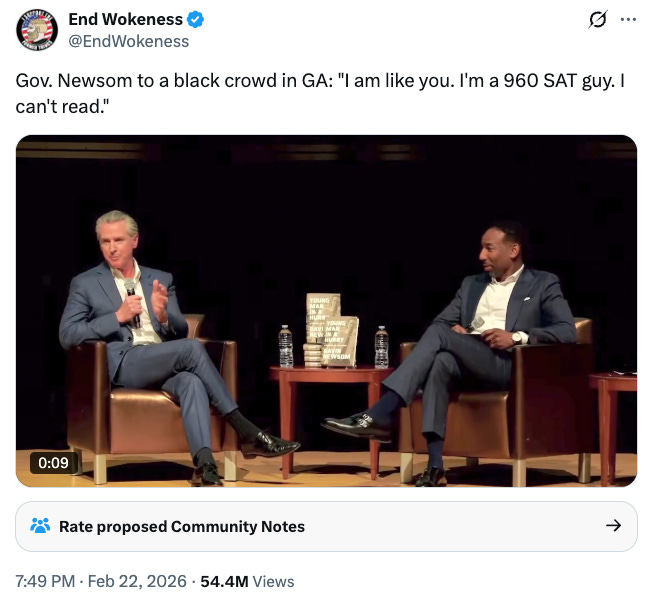
Gov. Newsom to a black crowd in GA: “I am like you. I’m a 960 SAT guy. I can’t read.”
Ted Cruz amplified it. Tim Scott amplified it. Nicki Minaj amplified it. Megyn Kelly said it would “haunt him forever.” Mark Levin said any Republican who’d said the same thing would see their career end. Rep. Randy Fine called on Democrats to demand Newsom’s resignation. Fox News ran it. RedState ran it. Townhall ran it.
But the quote, as presented in the tweet, is fabricated. Newsom didn’t say it.
What Newsom actually said, at a book tour event at the Rialto Center for the Arts in Atlanta on Sunday, was a longer, messier answer about living with dyslexia. He talked about discovering his diagnosis in his mother’s file cabinet. He talked about being the kid in the back of the classroom praying the teacher wouldn’t call on him. The key passage: “I’m like you. I’m no better than you... literally a 960 SAT guy, you’ve never seen me read a speech. Because I cannot read a speech. Maybe the wrong business to be in.” And then: “I haven’t overcome dyslexia. I’m living with it.”
End Wokeness compressed that into “I can’t read.” Those are not the same words. “I cannot read a speech” is a statement about dyslexia. “I can’t read” is a statement about illiteracy. They put quotation marks around a sentence Newsom never said, described the audience as “a black crowd” when video showed a mixed, possibly majority-white crowd (which even RedState acknowledged), and posted it to millions of people.
I want to be clear about something before we go any further, because I know how this reads. I really don’t like Gavin Newsom. I think his comments about trans athletes being “deeply unfair” to compete in women’s sports, delivered on a chummy podcast with Charlie Kirk of all people, were a calculated betrayal of a community he once ostensibly championed. I have a long list of problems with this guy. I do not want him to be the Democrats’ 2028 presidential nominee. Yesterday, as this was blowing up, I was on Bluesky criticizing him over something else. The reasons I don’t like him are all real. None of them require a fabricated or mangled quote.
And that’s the point. There is no shortage of legitimate things to criticize about this guy. Which makes it all the more worth asking why, instead of criticizing the things he actually says and does, people are responding to something he didn’t say.
This keeps happening
There’s a version of this pattern that’s been around for years, and it works every time.
In 2010, Nancy Pelosi told the National Association of Counties that the Affordable Care Act would be better understood once it was implemented, saying: “We have to pass the bill so that you can find out what is in it, away from the fog of the controversy.” Sixteen years later, millions of people still believe she said Congress needed to pass a bill they hadn’t read. The final clause, “away from the fog of the controversy,” changes the entire meaning. It’s always cut.
In 2012, Barack Obama gave a speech in Roanoke, Virginia, about how individual success depends partly on public infrastructure. Roads, bridges, teachers, firefighters. The line that went viral: “If you’ve got a business, you didn’t build that.” The “that” referred to infrastructure. The Romney campaign turned it into an entire convention theme (”We Built It”). Romney himself, in a speech five days later, acknowledged that Obama was talking about infrastructure. Then he kept using the distorted version anyway.
In 2016, Hillary Clinton told a fundraiser audience that “half” of Trump’s supporters could be categorized in a “basket of deplorables.” What almost nobody remembers is what she said next, because it’s always cut: she described a second basket, people who felt let down by the economy and the government, and said those people “need understanding and empathy.” The empathetic second half of the statement vanished, and all that survived was the word “deplorables.” Diane Hessan, who tracked undecided voters for the Clinton campaign, later wrote in the Boston Globe that the moment triggered the single largest shift toward Trump she observed during the entire race.
Every one of these followed the same formula. A longer statement gets compressed. The compression changes the meaning. The compressed version goes viral. The full version doesn’t.
What happened with Newsom yesterday fits the pattern, but there’s one detail worth pausing on. In every example above, the words that went viral were at least words the speaker actually said, just shorn of context. The End Wokeness post turned “I cannot read a speech” into “I can’t read.” That’s two dropped words. They’re the two words that make it a statement about dyslexia instead of a statement about illiteracy. And tens of millions of people saw the version without them.
The first version wins
Go back and look at the End Wokeness caption agaiin. “Gov. Newsom to a black crowd in GA: ‘I am like you. I’m a 960 SAT guy. I can’t read.’” You read that before you watched the clip. By the time you pressed play, your brain was already listening for those words, in that order. And you heard them. This is how priming works: you see a frame first, and it shapes what you perceive next. Social media captions and headlines do this constantly, and they’re very good at it. They resolve ambiguity before you encounter the actual clip.
But the priming is only half of it. The other half is what happens after someone points out that the quote was wrong. You’d think a correction would fix the problem. It mostly doesn’t. Psychologists call this the continued influence effect. The idea is that misinformation keeps shaping how people think even after they’ve been told it’s false. The first version of a story builds a model in your head, and when the correction shows up, it leaves a hole in that model your brain doesn’t want. So you keep the original. Even when you know better.
This is what it looked like with Ilhan Omar. In April 2019, Imam Mohamad Tawhidi posted a 19-second clip of Omar speaking at a CAIR event, captioning it with the claim that she “does not consider [9/11] a terrorist attack” and had described it merely as “some people did something.” That caption was the priming. What Omar was actually doing in the (roughly 20-minute) speech was arguing that American Muslims had been losing civil liberties since 9/11, and that it was unfair to be perpetually lumped in with terrorists. “Some people did something” was her way of drawing exactly that distinction. But right-wing media ran with Tawhidi’s framing. Dan Crenshaw. Ronna McDaniel. Brian Kilmeade, who asked on Fox whether Omar was “an American first.” The New York Post ran a front page with a photo of the Twin Towers being hit and the headline “Here’s your something.”
The correction never caught up. Almost seven years later, “some people did something” is still treated as proof that Omar dismissed the September 11 attacks. The first version won.
That’s what’s happening with the Newsom quote right now. The model is already built, and the caption did its work before anyone pressed play.