
The "Foremost War Skeptic"
The media made JD Vance. Now they’re protecting the investment.

If you’ve been following the news lately, you’ve noticed that the vice president of the United States has a reputation to protect.
Tyler Pager wrote in the New York Times that JD Vance “tried and failed to end a war he opposed.” Natalie Allison in the Washington Post called him the administration’s “foremost war skeptic.” NBC News went with “How JD Vance, skeptical of Trump’s war with Iran, came to lead the peace talks.” CNN headlined its story “How JD Vance went from well-known foreign war skeptic to the public face of peace talks with Iran.” Politico, back in March, reported that unnamed administration officials had described Vance as the “skeptical” voice in the White House on Iran strikes.
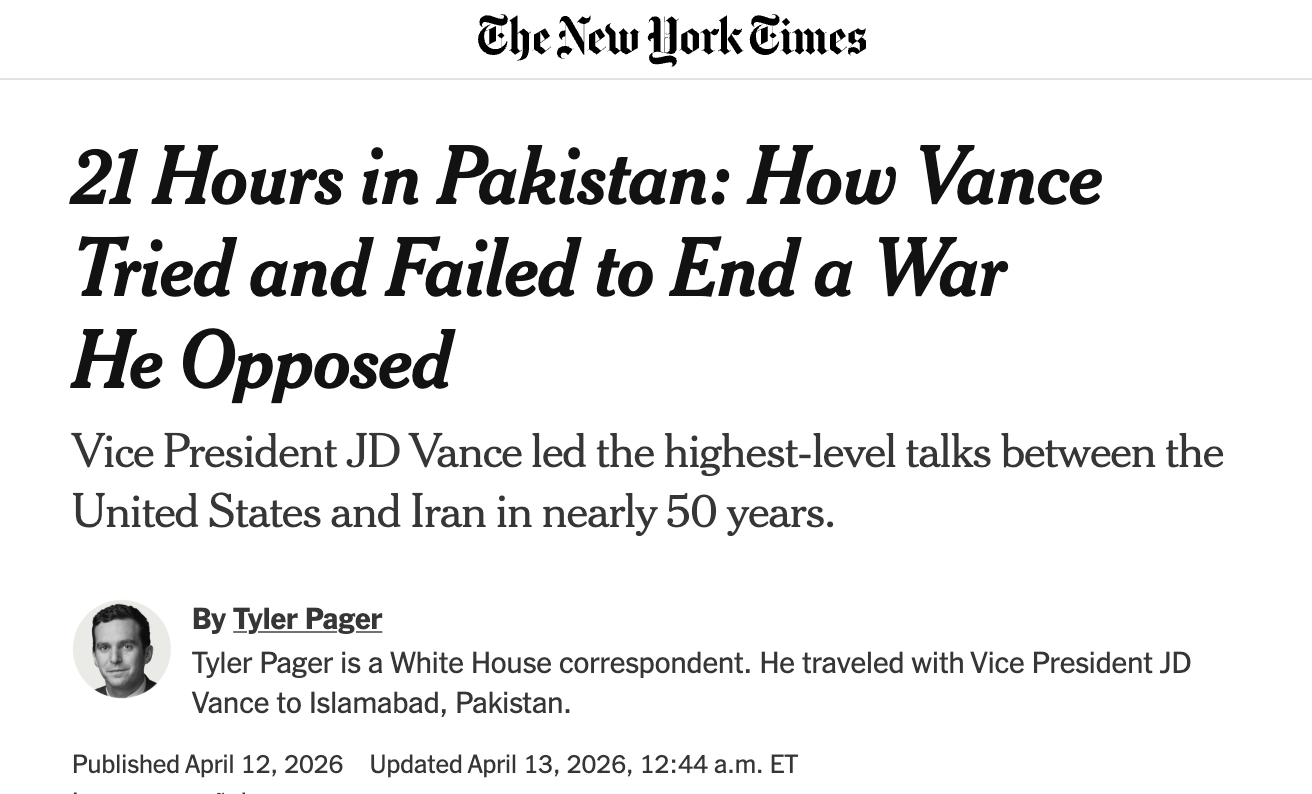
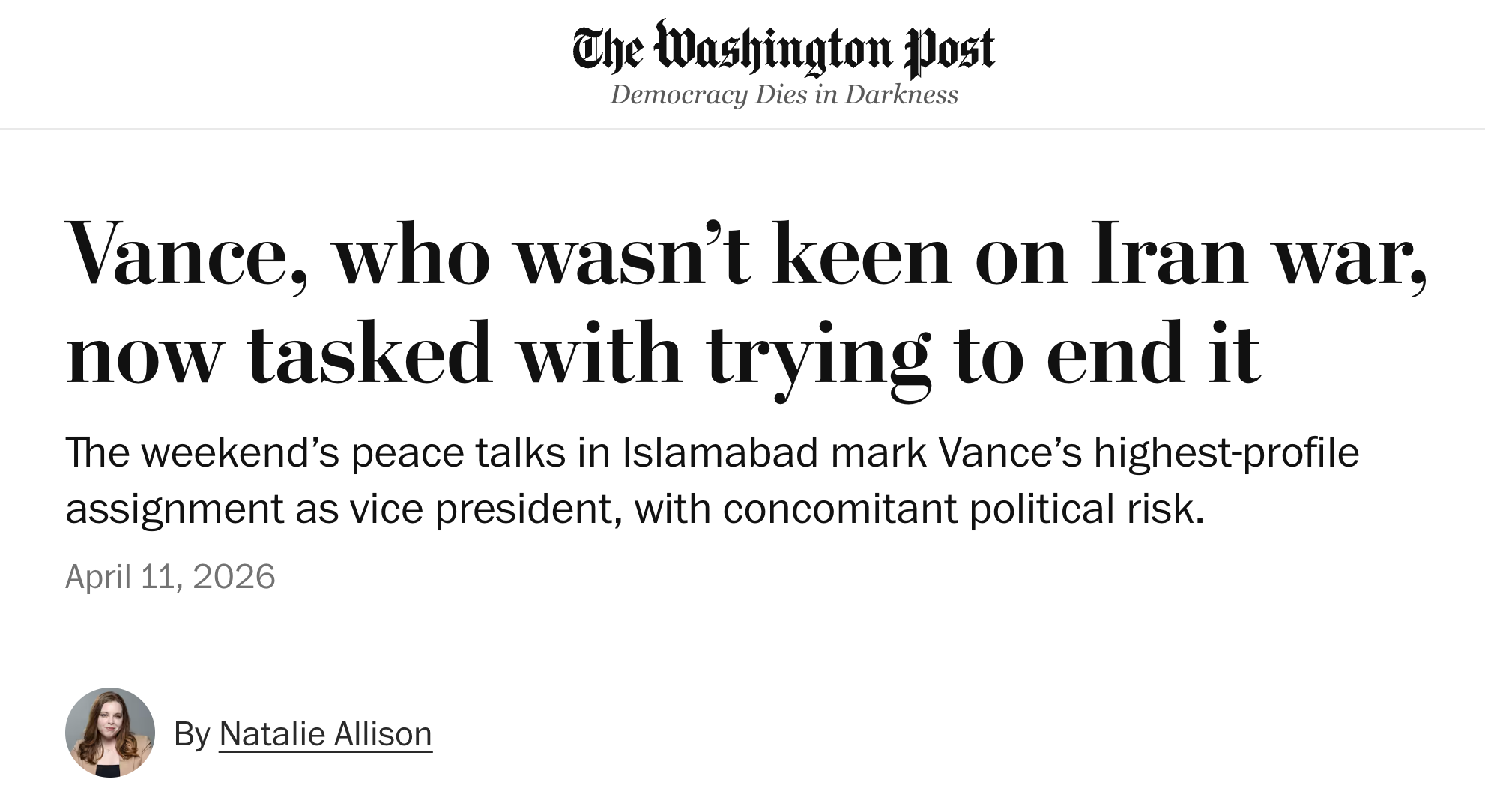
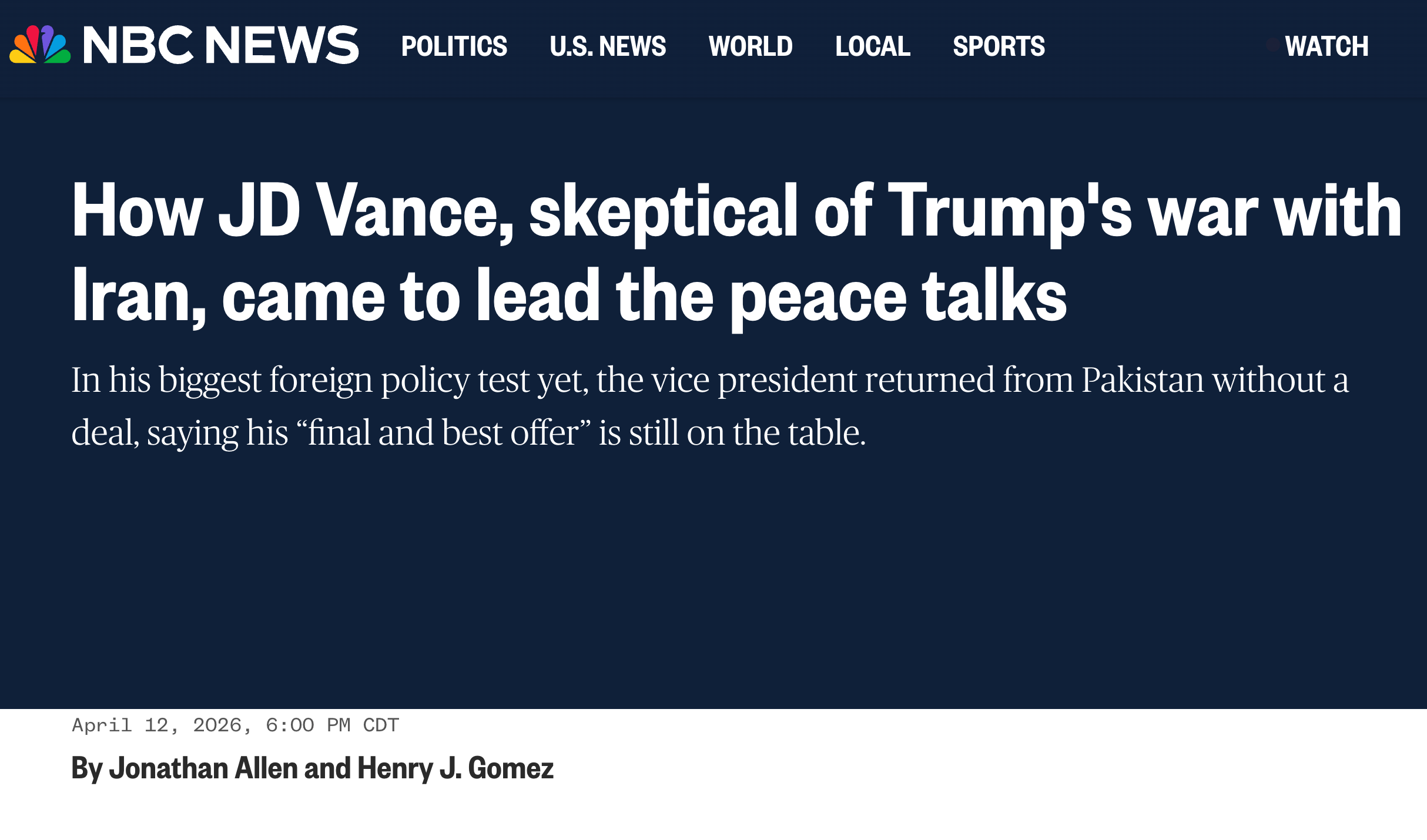

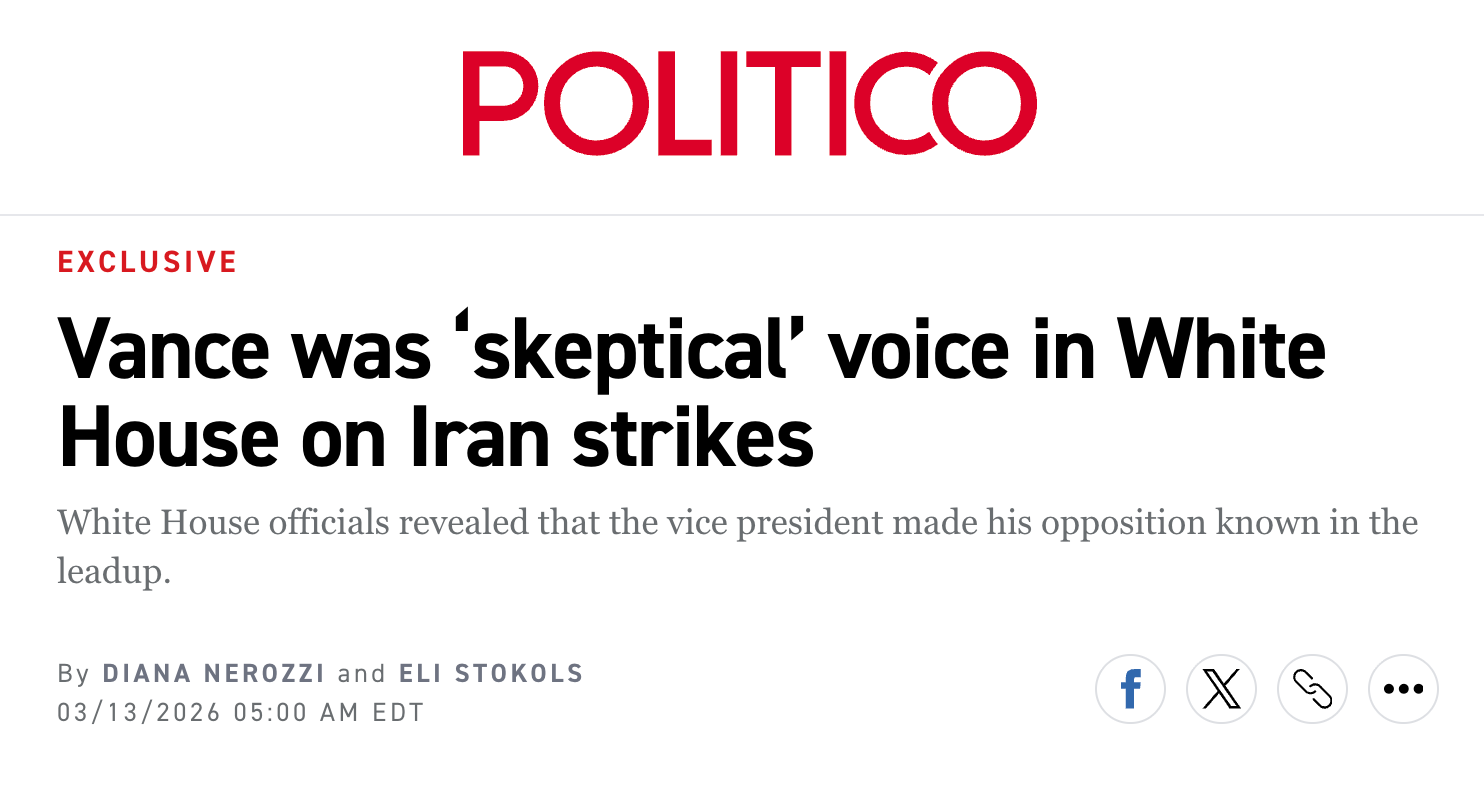
Five outlets. Same story. A man at the center of an administration that’s spent six weeks bombing Iran is, somehow, the one who didn’t really want any of this. Privately opposed. On a plane to Islamabad now to clean up a mess he didn’t make.
Read enough of these in a row, and a couple of things start to feel off.
First, almost none of what the reporters are telling you about Vance’s private views is sourced to anyone willing to put their name on it. Every “privately opposed,” every “worried about success,” every “tried to talk Trump out of it” traces back to “a senior administration official” or “people familiar with his thinking.” Second, none of it matches anything Vance has been saying in public, on camera, for the last year. What it matches is what a 2028 Republican primary campaign would want the press to be writing about its candidate right now, while an unpopular Middle East war is tanking his numbers with voters he’ll need in 2028.
Reporters know this, which makes publishing this narrative clearly being pushed by Team Vance that much more pathetic.
Here’s what he actually said.
Out loud and on camera.
Let’s start at the 2024 Republican National Convention. Sitting with Sean Hannity a few months before the election, Vance said this about Iran: “A lot of people recognize that we need to do something with Iran, but not these weak little bombing runs. If you’re going to punch the Iranians, you punch them hard. And that’s what he did when he took out Soleimani.” Around the same time, speaking with Morgan Ortagus (a foreign policy operative in Trump’s orbit), he called for an “aggressive” approach to Iran’s nuclear program. On Iran specifically, when the stakes were a podcast interview, Vance was a hawk arguing for harder strikes.
In June 2025, Trump ordered strikes on Iran’s nuclear facilities. Tucker Carlson publicly opposed them.
And Vance jumped on X with a long thread defending them. Here’s the line, verbatim: “Meanwhile, the president has shown remarkable restraint in keeping our military’s focus on protecting our troops and protecting our citizens.“
Sigh
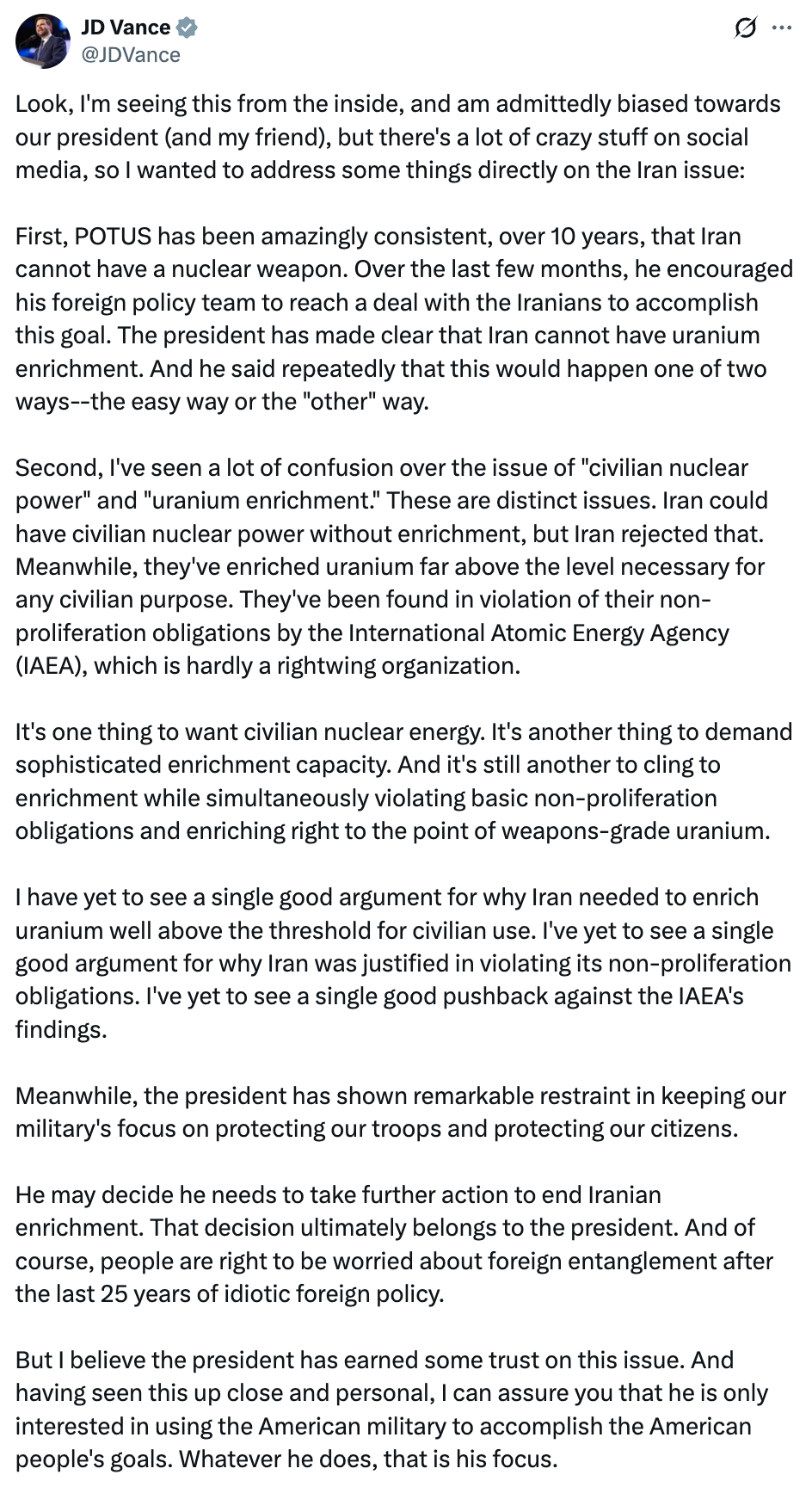
Remarkable restraint. Those are his actual words. In the same thread, he added: “People are right to be worried about foreign entanglement after the last 25 years of idiotic foreign policy. But I believe the president has earned some trust on this issue.” Many “war skeptic” pieces have been quoting this line as evidence that Vance gave credence to anti-war concerns. The line is actually Vance telling the skeptics to sit down and trust Trump. The press has spent a year quoting his actual words accurately and describing them wrong.
Two days before the current war began, Vance told the Washington Post: “The idea that we’re going to be in a Middle Eastern war for years with no end in sight — there is no chance that will happen.” The war is currently in its seventh week. Thousands dead. Talks just collapsed in Islamabad.
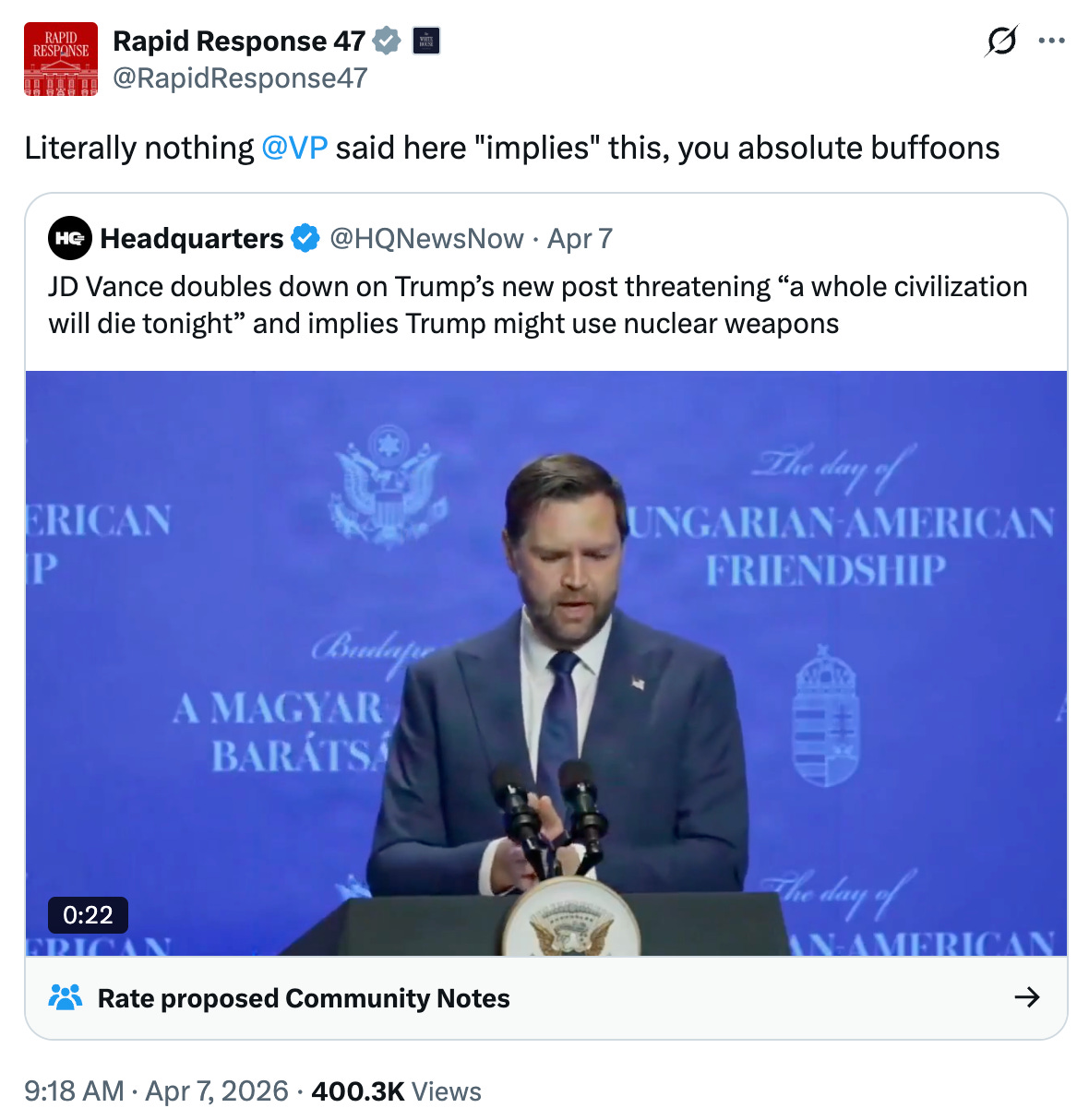
On April 7, at a press conference in Budapest with Viktor Orban, Vance warned that the United States had “tools in our toolkit that we so far haven’t decided to use” against Iran, and that the president “will decide to use them if the Iranians don’t change their course of conduct.” He said this the same day Trump was on Truth Social threatening that “a whole civilization will die tonight.” The “tools in our toolkit” line (which did not, to be clear, specify what kind of tools) was alarming enough that the White House had to post a rebuttal on X that read, “Literally nothing [Vance] said here implies this, you absolute buffoons.”
At the same press conference, Vance called Iran’s closure of the Strait of Hormuz “acts of economic terrorism” and mentioned that “there are still some things that we’d like to do, for example, on Iranian ability to manufacture weapons, that we’d like to do a little bit more work on militarily.”
And four days later, Natalie Allison in the Washington Post described JD Vance as “the administration’s foremost war skeptic.”
Dictation
So how does a man who publicly described Trump’s bombing of Iran as “remarkable restraint” get transformed, a year later, into the administration’s foremost war skeptic? You take dictation from people who won’t put their names on what they’re saying.
Count the anonymous sources. Marc Caputo and Barak Ravid at Axios: “a senior administration official,” “a source close to Vance.” Diana Nerozzi and Eli Stokols at Politico: “a senior Trump official” and “a person familiar with Vance’s thinking.” Adam Cancryn, Alayna Treene, and Kevin Liptak at CNN: “multiple people familiar with the matter.” The Reuters piece has four bylines and cites “one regional official and four people familiar with the talks.” Tyler Pager’s NYT piece quotes The Atlantic quoting somebody else. Unnamed sources all the way down.
Civil rights lawyer Alec Karakatsanis has a name for the move. He calls it the Big Deception, and he just published a book about it last year called Copaganda. The book is mostly about crime coverage, but the mechanism ports over pretty cleanly. The press presents anonymous claims about what powerful people privately believe as reported fact, and then uses that manufactured inner life to explain away everything those same people say and do in public. Karakatsanis’s go-to example is the war on drugs, which the press covered for decades as a good-faith public health initiative even though its actual purpose, later admitted by Nixon’s own aides, was to criminalize Black communities and the antiwar left. On Bluesky over the weekend, Karakatsanis pointed at Tyler Pager’s NYT headline and flagged the “tried to end a war he opposed” framing as the same move, now applied to foreign policy.
Which raises the question the pile of anonymous sources won’t answer on its own.
Why him?
JD Vance is their creation
JD Vance’s political career doesn’t exist without Hillbilly Elegy, and Hillbilly Elegy doesn’t exist as a political launchpad without a specific institutional decision, made in 2016 by the exact outlets now writing the war skeptic pieces, to elevate it as the book that would explain Trump voters to coastal readers.
Jennifer Senior in the New York Times called it “a compassionate, discerning sociological analysis of the white underclass that has helped drive the politics of rebellion, particularly the ascent of Donald J. Trump.” She went on: Vance had “inadvertently provided a civilized reference guide for an uncivilized election, and he’s done so in a vocabulary intelligible to both Democrats and Republicans. Imagine that.”
Imagine that. The NYT reviewer was openly marveling that a Trump-voter interpreter had managed to write in a dialect her audience could understand.
Joshua Rothman, reviewing the book for The New Yorker in September 2016, was even more direct about what was happening. Rothman wrote that anti-Trump conservatives had responded to Hillbilly Elegy‘s “largely empathetic portrait of poor, white Americans, which they see as an alternative to the less sympathetic theories about Trump’s least affluent supporters — ‘They’re all racist,’ essentially — that have become popular on the left.” Translated: the book gave well-meaning readers a way to feel like they’d done the homework on Trump voters without concluding anything uncomfortable. That was the product.
HarperCollins signed Vance to a sequel deal in 2017 for eight million dollars. For a sequel to a memoir. By a 33-year-old whose entire published output was one book.
For those who would like to financially support The Present Age on a non-Substack platform, please be aware that I also publish these pieces to my Patreon.
The rest of the lift was industry-wide. David Brooks blessed him in a New York Times column. Emily Esfahani Smith at the Wall Street Journal called the book “riveting.” Terry Gross booked him on Fresh Air. Hillbilly Elegy hit number one on the New York Times bestseller list, sold millions of copies, and became a Ron Howard Netflix movie in 2020 with Glenn Close and Amy Adams.
Take away that 2016 lift, and nothing after it happens. No 2022 Senate run. No Trump VP pick. No “foremost war skeptic” label in 2026. Every rung on the ladder ran through the same hands that are writing about him now.
The Trump conversion, which should have broken the whole thing open, didn’t. In 2016, Vance told Terry Gross he couldn’t “stomach” Trump. In a private message that later surfaced, he wondered whether Trump might be “America’s Hitler.” When he came back in 2024 as Trump’s running mate, the same outlets that had built him treated the reversal as a philosophical journey rather than a career move. NPR’s July 2024 retrospective on “the political evolution of J.D. Vance” played the old “can’t stomach him” clip from Fresh Air, then brought on David Frum to wonder aloud whether “conscious hypocrisy is a very rare behavior in human beings.” The question the segment wouldn’t ask was whether Vance had been playing them the whole time.
Then came the Iraq War. The single most durable lesson of American politics in the last quarter century is that tying yourself to an unpopular Middle East war is a career-ender unless you can document, on the record, that you didn’t really support it. Hillary Clinton’s 2002 Senate vote haunted her through two Democratic primary runs. Barack Obama beat her in 2008 largely because he could say he’d opposed the war from the start. Every ambitious politician watching took notes.
Vance, who is ambitious, took notes too. The skeptic narrative is his Iraq War inoculation, and the press is helping him build it in real time.
And the reporters aren’t even hiding the political angle. Reuters says Vance “stands to benefit politically if talks succeed.” CNN mentions his “political trajectory ahead of a 2028 contest.” The WaPo piece buries the polling down in the story: the Iran war is deeply unpopular with the general public and broadly supported by Republican voters. That’s the gap the skeptic-but-loyal framing is engineered to bridge. Republicans get the loyalty. General election voters get the reservations. The press gets to write both versions of the man at the same time and call it journalism.
Kamala tried this
Compare it to Kamala Harris. Her team tried to run the same play on Gaza. It didn’t stick.
In March 2024, NBC News reported that the National Security Council had watered down a Harris speech, softening her original draft’s language about Israel and Gaza. The sources? “Three current U.S. officials and a former U.S. official,” all speaking anonymously to brief reporters on the VP’s private views. The same sourcing model Vance is getting now. The framing was clear enough: Harris was privately pushing for a more humane approach to Gaza than Biden would allow.
It didn’t take. Harris herself kept going on camera and saying the opposite. At a firefighters union conference, she told reporters, “The president and I have been aligned and consistent from the very beginning.” In her first interview as the nominee that August, she told CNN her Israel policy would not differ from Biden’s. The press covered what she said out loud.
She lost. The DNC’s post-election autopsy reportedly concluded that Gaza may have cost her votes, but then buried the report. Harris had to publish a book a year later to tell her own “I pleaded privately with Biden” version of the story, and even the book got covered as spin.
Same play. Different VP. None of this is new. But it is working out better for Vance than it ever did for Harris.
The lessons of Iraq
The Iraq War was supposed to make this impossible.
Here’s how the system was supposed to work. A politician backs a disastrous Middle East war. The press pins them to that vote for years, in every campaign story that mentions their name. The politician pays a price at the ballot box. The next generation of ambitious politicians watches the price being paid, and thinks twice. That’s the whole mechanism. That’s how accountability for war works in a democracy, when it works at all.
The press is the institution that makes it work.
For Vance, the press is running the inoculation campaign. They’re laundering the anonymous quotes into news and printing the framing his comms team is handing them. They know what they’re doing. They’re doing it anyway.
If JD Vance becomes president in 2028, this is part of how it happens. Every outlet, all at once, all writing the same framing. By the time anyone in those newsrooms wants to admit the pattern, they will already have done the job.
Brilliant analysis of our billionaires’ lapdog press.
“By the time anyone in those newsrooms wants to admit the pattern, they will already have done the job.”
Thank you Parker again for your incisive, insightful analysis that reaches across the specifics to reveal the mechanism that lurks beneath. I also appreciate that you widen the lens to show how Harris was not nearly as successful with this approach and leaves us to draw our own conclusions there.
Thank you for naming the dissonance and clearly laying out the timeline. In this time of personal overwhelm, I am very grateful for your writing which provides greater understanding and invites me to move beyond superficial dismissals.
🙏