


On October 12, 2001, as the House took up the bill that would become the USA PATRIOT Act, Rep. Peter DeFazio (D-OR) told his colleagues, “This is still warm. It just came off the Xerox machine.” He asked House leadership, according to the Congressional Record, to “withdraw this bill, give us a weekend to read it, and let us take it up Monday morning.”
They... didn’t. The House passed it that day. Two weeks and a rewrite later, President George W. Bush signed the final bill into law on October 26, 2001, 45 days after the September 11 attacks. That makes today the law’s 25th birthday.
How did this happen? Well, people were pretty freaked out following 9/11 (members of Congress very much included), and the people in charge kept telling us this was needed to prevent another attack from happening. So the bill sailed through the Senate 98-1. Good luck getting re-elected if you vote against something called the Patriot Act just weeks after the worst terrorist attack on American soil.
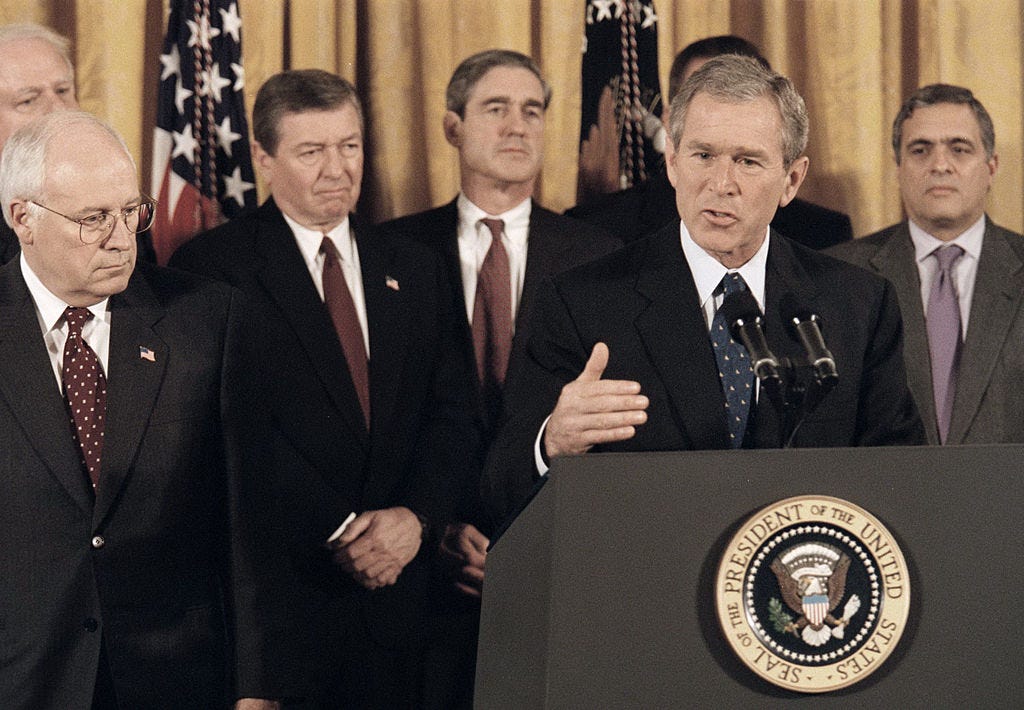
In September I wrote that the government used the attacks to justify attacking our civil liberties, and this is a big part of how that happened.
I’ve also been thinking about how a lot of younger people don’t really remember a world before the Patriot Act. We just sort of accept it. So let’s review it.
The Bush administration shared a draft of the proposed bill with Congress about a week after 9/11. It went far enough that Rep. Jim Sensenbrenner (R-WI), the Judiciary Committee chairman, told the Milwaukee Journal Sentinel, “I thought the original Justice Department proposal went far too far.”
But Attorney General John Ashcroft just wanted it passed. Every day without the new powers, he told the Judiciary Committee on September 24, was “a day that terrorists have a competitive advantage.” On October 2, he went on CNN’s Larry King Live and said, “We need the tools to fight terrorism. Talk won’t prevail against terrorism. But tools can do so.” Asked whether the bill would pass, he said he believed it would. “But I have been a little bit — frankly, I have been disappointed with the pace.” His draft had been on the Hill for about two weeks.
The press was getting reminders of its own. On September 26, asked about Bill Maher’s comments on Politically Incorrect, White House press secretary Ari Fleischer told reporters that Americans “need to watch what they say, watch what they do.” That line was missing from the White House’s official transcript at first. The stenographers’ office later told American Journalism Review it had simply been overlooked, and the transcript was corrected. Two days later, Fleischer said he had “made some concerns known to the media, which I’ll continue to make known on a private level.” On October 16, PBS NewsHour ran a segment on the limits of dissent that included two small papers: the Daily Courier in Grants Pass, Oregon, had fired its columnist Dan Guthrie, and the Texas City Sun had let go its city editor, Tom Gutting, both over columns criticizing Bush for not heading straight back to Washington on September 11.
And on October 10, after a conference call with national security adviser Condoleezza Rice, the five major TV news organizations agreed to edit any future Osama bin Laden tapes. The New York Times called it “the first time in memory that the networks had agreed to a joint arrangement to limit their prospective news coverage.” The Senate voted on the bill the next night.
As for the bill itself, the media watchdog FAIR found in late September that neither CBS Evening News nor NBC Nightly News had aired a single report “exploring the legislation’s potential impact.”
Sensenbrenner and the committee’s top Democrat, Rep. John Conyers (D-MI), worked out a narrower bill than the White House wanted, with a two-year sunset on the new surveillance powers, and on October 3 the committee passed it 36-0. They called it the “Provide Appropriate Tools Required to Intercept and Obstruct Terrorism” Act, or PATRIOT.
The Senate skipped the committee step. Sen. Russ Feingold (D-WI) wanted to offer four amendments, including one that would let agents listen in on a roving wiretap only when the target was actually on the line, and another limiting the FBI’s new power to demand business records. “I can’t quite understand why we can’t have just a few hours of debate,” he said. The three amendments he offered were voted down on October 11, and the Senate passed its bill 96-1 that night.
“That is the best I can do”
That left the House with a bill its own committee had passed unanimously and a separate bill from the Senate. The normal thing (you know, the one from high school civics?) would’ve been for the House to pass its version and work out the differences with the Senate in a conference committee. Instead, on Friday, October 12, House Republican leadership skipped all of that and brought a substitute to the floor. So whose bill was it? It was the Senate’s. “It is the text that was introduced in the Senate by the Democratic leader of the Senate, the Senator from South Dakota (Mr. Daschle),” Sensenbrenner told the House, with some of its provisions taken out and some of the committee’s ideas put in over the previous 48 hours.