
They Know What "Wrong Place, Wrong Time" Means
Right-wing media has a formula: take a common phrase, pretend it means something monstrous, and pound away until a scandal exists. They just did it to a Chicago alderwoman.

I used to live in Rogers Park, here in Chicago. I used to walk along the lakefront by Loyola University. I’ve walked out on that pier at Tobey Prinz Beach, the one where Sheridan Gorman was recently killed.
Gorman was 18 years old, a freshman at Loyola from Westchester County, New York. On March 19, she was out with a group of friends near the beach around 1:30 in the morning. They’d gone to catch a glimpse of the northern lights. A masked man emerged and fired at them. Gorman was hit and died at the scene. It was the first homicide in the city’s 49th Ward all year.
This isn’t an area people think of as dangerous. Rogers Park is a dense, walkable, genuinely diverse neighborhood on the far north side of Chicago. The lakefront there is full of joggers, dog walkers, students. Gorman’s murder was shocking because of how normal her evening was, and how safe the area generally feels. I know this because I lived there. I know this because I walked those same blocks.
Shortly after the shooting, 49th Ward Alderwoman Maria Hadden did an interview with Fox 32 Chicago. The anchor asked whether this was a targeted incident, whether residents should be worried for their safety. Hadden, relaying what police had told her, said it appeared to be random. She used the phrase “wrong place, wrong time.” The rest of the interview was grief, community resources, and support for a shaken neighborhood.
Within days, Hadden’s comments had been ripped from that interview, stripped of the question she was answering, repackaged by right-wing influencer accounts with words she never actually said placed inside quotation marks, and blasted across conservative media. Fox News ran multiple national articles. Megyn Kelly covered it for days. House Republicans held a press conference on Capitol Hill with photos of Gorman on display. Trump invoked the case in remarks about ending sanctuary cities. The narrative that took hold was that a progressive Chicago alderwoman had blamed a murdered teenager for her own death. Hadden had to close her ward office over safety concerns.
The phrase “wrong place, wrong time” is one of the most common expressions in the English language for describing random violence. Police departments use it. Families of victims use it. Local news stations across the country have used it in headlines. In fact, one of Gorman’s own friends, someone who was standing on that pier when the shooting happened, independently told the Chicago Sun-Times the exact same thing: “It seemed like he was there for a reason, and we were just [in the] wrong place, wrong time.” Nobody accused that friend of victim-blaming. Nobody built a news cycle around it.
Everybody knows what “wrong place, wrong time” means. The people who turned it into a scandal know what it means, too. They just pretended not to.
This is a thing the right does. It’s a formula I’ve been tracking for years, one I wrote about repeatedly when I was at Media Matters for America: take something a Democrat said, detach it from context, assign it the most absurd possible meaning, and then attack the meaning you invented. It works because it’s simple, because it’s fast, and because the people doing it understand that the correction never catches up to the lie.
What happened to Maria Hadden is the latest, and in some ways the most brazen, example of how this machine works.
Watch the actual interview
If you’ve seen coverage of what Hadden said, you almost certainly haven’t seen the interview itself. So here’s the exchange that launched a national scandal.
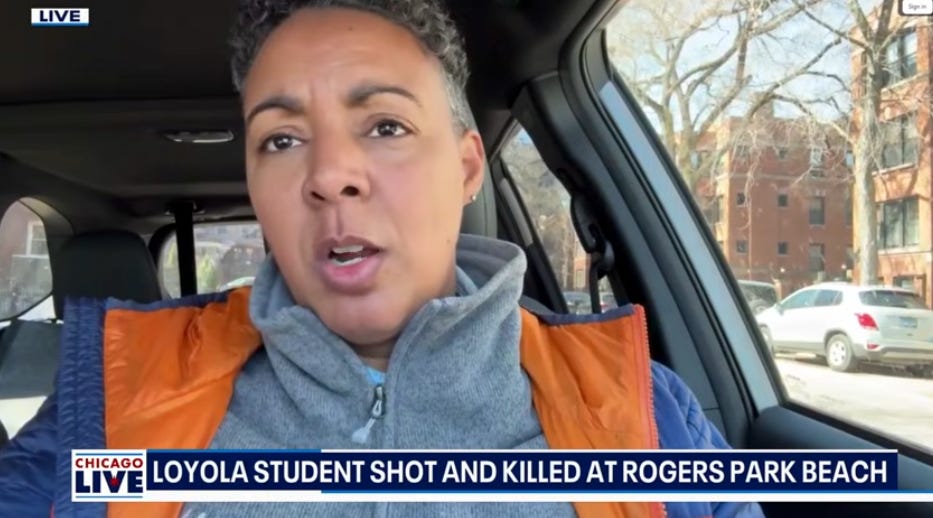
The Fox 32 anchor, noting that the shooter wore a mask and that people were scared, asked Hadden directly: “Should other people be concerned about their safety right now, or do we think that this is a targeted incident?”
That’s the question. Remember it, because you’ll never see it in any of the coverage that followed.
Hadden answered:
So from what I’ve been told so far, right, from what police know, from speaking to the students who were with her, it seems — she might have — that as they were just out, you know, people go out to the beach all the time, right? And they go out on the pier. They walk around. So the kids were out doing normal things people do in the neighborhood, and it sounds like this might have been a wrong place, wrong time, running into a person who had a gun. They might have startled this person at the end of the pier unintentionally. But that’s all we know. So from what I’ve been told, what police investigation has turned up so far, what they’ve been able to share with me and with Loyola University, we don’t believe there is cause for broader community concern at this time.
That’s it. That’s the answer. She’s telling a frightened community that, based on what police shared with her, this doesn’t appear to be a serial attacker or someone targeting students.
The rest of the interview is Hadden talking about grief and community support. “I’m sad,” she told the anchor. “Rogers Park is a very warm, welcoming, almost small-town-like community, a neighborhood in the city of Chicago, and this really shakes you to your core.” She talked about how a killing like this “brings up trauma from previous issues” the neighborhood has dealt with, and urged anyone struggling to reach out to her office. The anchor’s final words to her: “Thank you so much again. We appreciate you.”
Nobody in that conversation thought anything offensive had been said. The anchor didn’t push back. She didn’t ask a follow-up. She thanked Hadden and moved on, because Hadden had done exactly what a local elected official is supposed to do after a shooting in her ward: share what she knew, reassure people, and point them toward resources.
Here’s what the viral clip contained:
...all the time, right? And they go out on the pier. They walk around. So the kids were out doing normal things people do in the neighborhood, and it sounds like this might have been a wrong place, wrong time, running into a person who had a gun. They might have startled this person at the end of the pier unintentionally.
The question was cut. The beginning of her answer, where she’s clearly relaying secondhand information from police (”from what I’ve been told so far, right, from what police know”), was cut. The sentence immediately following (”But that’s all we know... we don’t believe there is cause for broader community concern”) was cut. Everything about grief, community resources, and mental health support was cut. What remained was a fragment of an answer with no visible question, which made it look like Hadden had volunteered this framing unprompted, as her considered take on a teenager’s murder, rather than what it actually was: an answer to “should my neighborhood be scared right now?”
And keep in mind: at the time of this interview, no suspect had been identified. Police hadn’t arrested anyone. Nobody knew who the shooter was. Hadden was doing her best to relay the limited information CPD and Loyola had shared with her. The right-wing accounts that later framed her comments as defending “a migrant” were retrofitting an immigration narrative onto words spoken before anyone knew the first thing about the killer. She wasn’t defending anyone. She was passing along what the police told her.
Removing the question isn’t sloppy editing. It’s the entire trick.
What they said she said
The clip was bad enough on its own. But the accounts that made it go viral didn’t stop at removing context. They improved on what Hadden said.
Here’s the tweet from End Wokeness, the right-wing influencer account that first pushed the clip into the conservative media bloodstream on March 23:
Chicago Alderwoman Maria Hadden: Sheridan (18) was in “wrong place at the wrong time — she might’ve startled the migrant who kiIIed her”
And, again, here’s what Hadden actually said:
“...it sounds like this might have been a wrong place, wrong time, running into a person who had a gun. They might have startled this person at the end of the pier unintentionally.”
Look at what changed. Hadden said “a person who had a gun.” End Wokeness wrote “the migrant.” Hadden said “they,” referring to the group of students. End Wokeness wrote “she,” pinning the blame on Gorman individually. Hadden never said “killed her.” That was invented and placed inside quotation marks. The whole thing is formatted as a direct quote, but it isn’t one. It’s a rewritten version of her remarks with new words stuffed in. Now, you might see this and think that these are just small differences, but they can play a big role in propaganda.
Then there’s the Libs of TikTok version, which added another layer entirely:
Maria Hadden, a Chicago Alderwoman and a self-described “queer & progressive champion”, says Sheridan Gorman was m*rdered because she “might’ve startled the migrant who k*lled her.” This is who’s running your city.
Same altered quote, but now with Hadden’s sexual orientation and political identity presented as relevant context. The framing is telling the audience that Hadden’s supposed indifference to Gorman’s murder is a queer progressive trait. Not an individual failing, but a type. (And, I should note, that I’m not sure where the “queer and progressive champion” language is coming from; I was unable to find it.) “This is who’s running your city” seals it. The tweet isn’t really about what Hadden said. It’s about what she is.
These two tweets are the foundation everything else was built on. The entire national news cycle, from cable news to the Capitol, traces back to a version of Hadden’s words that Hadden didn’t exactly say.


And this isn’t even new.
I’ve seen this before
When I was at Media Matters for America, I wrote about the time Eric Holder, speaking at a voter suppression event in support of Stacey Abrams in October 2018, riffed on Michelle Obama’s “when they go low, we go high” line. “When they go low, we kick them,” Holder said. Then he clarified, immediately, in the same remarks: “I don’t mean we do anything inappropriate. We don’t do anything illegal.” Right-wing media clipped the clarification and ran with the first part. Fox & Friends’ Ainsley Earhardt: “Just start kicking people? That’s the former head of the Justice Department.” Lou Dobbs called Holder an “illustrious thug.” The Daily Wire, Gateway Pundit, Breitbart, the Federalist, and RedState all published pieces treating a voter suppression metaphor as a literal call to assault.
Everyone knew what “kick them” meant. They pretended not to.
A few months later, I wrote about Kirsten Gillibrand saying at a 2019 campaign event that undocumented immigrants should have the right to pay into Social Security, pay taxes, and have a pathway to citizenship. The RNC posted an 18-second clip to YouTube titled “Sen. Gillibrand: Expand Social Security To All Illegal Immigrants.” Laura Ingraham picked it up that same night. By the next day, Mike Huckabee was on Hannity telling viewers that Gillibrand wanted to take “grandma’s Social Security” and give it to people “who broke into this country illegally.” She’d said the opposite. She was talking about people paying into the system, not taking from it. Fox ran it on both its “news” and “opinion” programming, and the chyrons on the “news” side even included a fabricated quote.
Everyone knew what “pay into Social Security” meant. They pretended not to.
Then there was Ilhan Omar, who I wrote about in April 2019 after she gave a 20-minute speech at a CAIR fundraiser about the challenges American Muslims face. Her point was that after 9/11, all American Muslims started losing access to their civil liberties because of what a small group of people did. She referred to the hijackers as “some people” because the entire point of her speech was to distinguish ordinary Muslims from terrorists. A 19-second clip was extracted. Brian Kilmeade on Fox & Friends: “You have to wonder if she’s an American first.” The New York Post ran a front-page photo of the Twin Towers burning with the headline “Here’s your something.” Omar had already been the target of assassination threats before this.
Everyone knew what “some people did something” meant in context. They pretended not to.
And I wrote about Joe Biden arguing at a 2019 forum that Democrats needed to work within the system, telling an audience of activists that if they didn’t want to do the hard work of winning votes, “let’s start a real, physical revolution if you’re talking about it.” It was sarcasm. It was a challenge to people who thought there was a shortcut. Ryan Saavedra at the Daily Wire posted a 51-second edit that cut everything before and after the line, making it sound like Biden was the one calling for revolution. Mark Levin tweeted: “Biden suggests ‘physical revolution’ aka violence.” The clip could have included the full context without editing (it was under Twitter’s video limit), but Saavedra cut it anyway.
Everyone knew what Biden meant. They pretended not to.
Four examples, same formula every time: clip a Democrat’s words, drop the context, apply the dumbest possible reading, and treat it as self-evident. The infrastructure is always the same, too. A short clip or tweet goes up. Conservative media amplifies it. Fox runs segments. Politicians weigh in. By the time anyone points out what was actually said, the scandal has already been absorbed as fact by millions of people who will never see the correction.
But the Hadden case goes further than any of those. “Wrong place, wrong time” isn’t even a figure of speech that requires charitable interpretation. “We kick them” is a metaphor. “Physical revolution” is a hypothetical. “Some people did something” is a deliberate understatement being used to make a rhetorical point. You can see, at least, how a bad-faith actor could grab any of those and run. But “wrong place, wrong time”? It’s not figurative. It’s not rhetorical. It’s just what people say when someone gets hurt by random violence. CNN ran an entire analysis piece in 2023 built around the phrase. It’s in police reports. It’s in obituaries. There’s nothing to misunderstand. You have to choose to misunderstand it.


The scandal that wasn’t
I’m not arguing that Hadden’s interview was flawless. Saying the students may have “startled” the gunman was clumsy, even in the context of relaying preliminary information from police. It put a piece of the causal chain on the victims’ actions, and I can see why that stung. But the gap between “clumsy phrasing in a live interview hours after a murder, before police had identified a suspect” and “Democrat blames murdered teenager for her own death” is vast. The entire right-wing campaign required collapsing that gap, and they did it by cutting a question, fabricating a quote, and pretending not to understand a phrase that every adult in America has heard a thousand times.
I give you a lot of credit, Parker. This media landscape gets dumber and dumber, but you're still out here doing the Lord's work by covering it. I can't thank you enough for your service.
Thanks, Parker. Great reporting and analysis! I'm tempted to say "well, there they go again"