


Hey all, Parker here.
Over at The Atlantic, Yair Rosenberg has a really good piece about context, and I highly recommend you read it1.
He opens with an anecdote about the way the promotional team behind “Terminator 3: Rise of the Machines” stripped context from a two-and-a-half-star Roger Ebert review and used “wall-to-wall action” (in context: “‘Terminator 3: Rise of the Machines’ … abandons its own tradition to provide wall-to-wall action in what is essentially one long chase and fight, punctuated by comic, campy or simplistic dialogue.”) in its marketing for the film.
But first, real quick: here’s the part of the newsletter where I ask you to consider signing up for the free version if you’re new here and ask existing free subscribers to consider upgrading to the paid version.
Personally, my favorite example of this sort of context-stripping comes in graphic design form. If you haven’t seen this yet, you’re in for a treat. It’s a poster promoting Tom Hardy’s 2015 film Legend. That’s a lot of stars. Seems like it was pretty universally beloved, right? Do you see it yet?
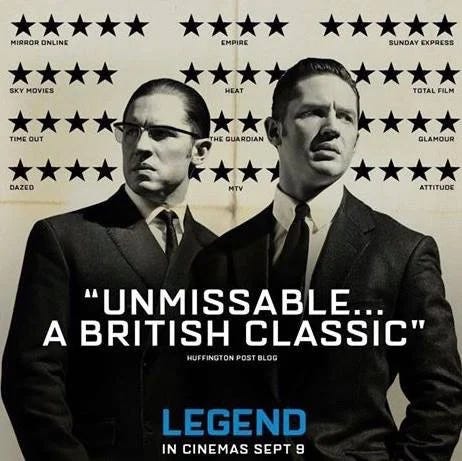
Right in the middle, hidden in plain sight, is The Guardian’s two-star review. Now, the poster is not technically lying. The Guardian is listed, and yes, right above it are two stars — but come on, we can all see what they were going for here, right? The photos of Hardy partially obscure stars from a number of other outlets, such as Glamour and Total Film, so the casual observer would be forgiven for thinking that there were some extra stars hidden behind those handsome heads. But there weren’t. The review was taken from its proper context and used to hype a film that it referred to as both “cartoonish” and “pedestrian.”
But I digress…
From the “T3” anecdote, Rosenberg makes the point that “since October 7, many otherwise thoughtful and intelligent people have abandoned context and turned themselves into the political equivalent” of that film’s PR team, something that is of considerably higher stakes than any movie’s box office numbers. I find that difficult to argue with.
In one example, Rosenberg illustrates how Rep. Elise Stefanik (R-NY) backed three college presidents into a context-lacking corner during a now-notorious December hearing about antisemitism on college campuses, drilling specifically into how the congresswoman repeatedly took two phrases that are extremely context-dependent, framing them as inherently genocidal, and then asking the school presidents whether or not genocidal language violated school policies.
Here’s Rosenberg [bolded emphasis mine]:
Stefanik opened by invoking slogans that have become commonplace at pro-Palestinian rallies: “From the river to the sea, Palestine will be free” and “Globalize the Intifada.” These phrases, Stefanik said, were calls for the murder of Jews. She then cannily conflated the chants with advocacy for the genocide of Jewish people. But [then-Harvard President Claudine] Gay and her fellow college presidents at the hearing refused to accept this framing of the slogans. When asked point-blank whether “calling for the genocide of Jews violates Harvard[’s] code of conduct,” Gay replied, “It depends on the context.” With this answer, Gay was not condoning genocidal advocacy—she had explicitly called such speech “abhorrent” earlier in the proceedings. Rather, Gay was rejecting Stefanik’s assumption that the specific slogans she’d mentioned always violated Harvard’s code of conduct and necessarily constituted calls for actual genocide. In this, Gay was correct.
But it didn’t matter that Gay was correct. The trap was in the question, itself. Had she answered “yes,” she and other school presidents would then be expected to crack down on protected speech that very much doesn’t violate school policies. This would have the side benefit to Stefanik of painting college administrators as to-that-point tolerant of genocidal language and portraying the broader pro-Palestinian movement as inherently antisemitic.2 Had she answered “no,” she and other school presidents would have come off as indifferent to rising antisemitism on campus and elsewhere.
This is not a defense of those slogans, which have very complicated histories. This is simply to say that no, they are not inherently and, without exception, antisemitic3.
The only answer that tells a complete story is one more complicated than “yes” or “no” in that situation. The goal of that line of questioning was to force Gay and the other school presidents to abandon context and nuance in favor of simplicity.

I watch plenty of congressional hearings, and this is not some novel tactic. Heck, you can see this happen in every “Law & Order” re-run since the beginning of time: a lawyer will pose a complicated question to an expert witness; that witness will offer a complicated answer; the lawyer will demand a “yes” or “no” answer.
That’s effectively what Stefanik did, and it was successful. To the extent that Gay was able to blurt out an answer more complex than a simple “yes” or “no,” it was that context mattered. Of course, it does. But go look at Twitter in the days that followed, and you’ll see that “depends on the context” became a meme. No conversation was advanced. Instead, the hearing became just another bit of fodder in an ongoing information war, a fundraising opportunity, an excuse to try to push organizations like Harvard in one political direction or another.
We could have had a conversation about the broader context and about trying to address issues of rising antisemitism on college campuses, but that wasn’t what that hearing was ever actually about.
And in another example of omitted context obscuring the more complicated nature of world events, Rosenberg makes a point about the recent proceedings at the International Court of Justice [bolded emphasis mine]:
A similar scene unfolded last month at the International Court of Justice, but with the charges of genocidal incitement reversed. Lawyers for South Africa leveled these allegations at Israel, and central to their claim were several shocking statements from Israeli Defense Minister Yoav Gallant: “Gaza will not return to what it was. We will eliminate everything.” “We are fighting human animals.” These quotes were crucial to the case, because under the Genocide Convention, the crime entails not simply destruction but demonstrable intent among top decision makers “to destroy, in whole or in part, a national, ethnical, racial or religious group.”
But as I documented last month, the quotes attributed to Gallant were either incorrect, truncated, mistranslated, or stripped of essential context. In each case, the defense minister was referring to destroying Hamas, not Gaza or Gazans. And the proof was all available on video. On October 10, speaking at the Gaza border to soldiers and police who had repelled the Hamas terrorists who murdered more than 1,000 Israelis, Gallant said: “Gaza will not return to what it was before. There will be no Hamas. We will eliminate it all.” (Emphasis added. The New York Times, the Associated Press, NPR, and The Guardian, among others, corrected their quotations following my report.) In the same short speech to the border defenders, Gallant explained to whom he was referring as “human animals”: “You have seen what we are fighting against. We are fighting against human animals. This is the ISIS of Gaza.” Given that Gallant was speaking directly to those who had battled Hamas, and that both American and Israeli officials have likened the group’s acts to those of the Islamic State, there can be no mistake about what the defense minister meant. The context is key.
I hope we can all agree that there’s a big difference in meaning between “Gaza will not return to what it was before. … We will eliminate it all.” and “Gaza will not return to what it was before. There will be no Hamas. We will eliminate it all.” What is the “it” that will be eliminated here? Is it Gaza, as the first quote states? Or does it seem to be Hamas, as the second quote would suggest?4
Why omit it? You can believe that Israel’s heavy-handed military response to the October 7th attack constitutes genocide without omitting “There will be no Hamas” from Gallant’s quote. You can certainly make the case that Gazan civilians are being oppressed and there’s no doubt that innocent civilians are being killed. Even so, I can understand why someone who disagrees with that position would take issue with the omission of “There will be no Hamas,” in that it adds unnecessary ambiguity.
The same goes for Gallant’s infamous “human animals” comment, which was understood at the time of his saying it to be specifically about Hamas militants.
From a Huff Post article published on October 9 [bolded emphasis mine]:
Israel formally declared war on the Hamas militant group on Sunday, pointing to the large military mobilization that has already killed nearly 500 people in Gaza, including women and children. Hamas claims it has taken about 100 captives from the attacks.
“We are fighting human animals and we act accordingly,” Gallant said.
While it appears that Gallant was specifically referring to Hamas fighters in that comment, the rest of the minister’s remarks called for further oppression of all people in Gaza by denying them basic human needs.
“We are imposing a complete siege on Gaza,” Gallant said. “There will be no electricity, no food, no water, no fuel. Everything will be closed.”
This essay is not about Israel, Palestine, Hamas, or Harvard. It’s about context, generally. These are just prominent examples.
Here’s how Rosenberg ends his piece [bolded emphasis mine]:
Just as decontextualizing campus chants can wrongly lead to pro-Palestinian activists being tarred as genocidal anti-Semites, the ICJ’s misrepresentation of Gallant miscast an opponent of Israel’s hard right as one of its allies. As it turns out, whether it’s “From the river to the sea” or “Eliminate it all,” context matters—and that cuts both ways.
Political partisans tend to appeal to context when it supports their stance and ignore it when it complicates their narrative. This approach is useful if you are trying to win an argument, but it is deeply counterproductive if you are trying to understand reality. For the rest of us, stories like these are a reminder that there are better ways to learn about the world than from incendiary viral videos and selective citations.
The line I bolded? That’s the line that stuck with me.5 Because I see it everywhere. For instance, check out this recent tweet from the Daily Wire’s Matt Walsh:
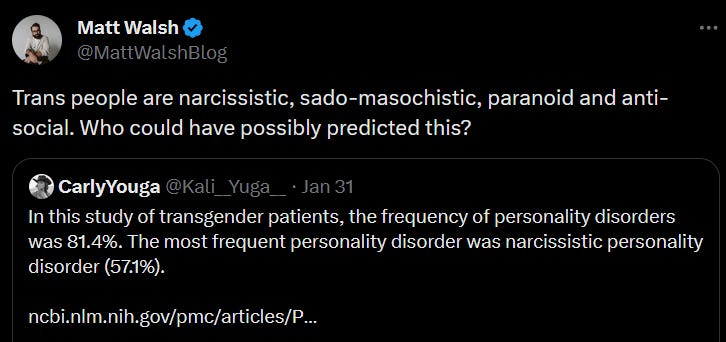
Oh wow, a “study of transgender patients” said that? Would you care to learn the context of that study? Well, it turns out that it’s from a decade ago, was published by The Medical Journal of the Islamic Republic of Iran, had a sample size of just 73 from a single clinic in Iran, and used a scientifically unreliable self-report tool called the Million Clinical Multiaxial Inventory-II. Oh, and the lead author of the study has since completed a follow-up study that was inconsistent with his original findings.
Mira Lazineat Assigned Media has a great breakdown of all of this.
But hey, that’s context. Who needs context when you can instead argue that 81.4% of the people your colleagues have repeatedly called for “eradicating”6 have personality disorders, right?

See? This is, to borrow from Rosenberg’s point, an effort to ignore context when it complicates a narrative. If the context were to benefit their narrative, they’d have included it. Walsh is a pundit. His goal is not to help you understand reality but to convert people to his side in a war against trans people.
You can do this with any topic, really. Still, this line… this is going to stick with me:
This approach is useful if you are trying to win an argument, but it is deeply counterproductive if you are trying to understand reality.
Let’s all strive to better understand reality, even if it comes at the expense of winning arguments.
Corrections:
In the February 5, 2024, edition of TPA (“W. Kamau Bell Wants to Talk to The People Who Want to Hear From Him”), Sara Haines’s name was initially misspelled as “Sarah Haynes,” John Quiñones’s name was initially misspelled as John Quinones, and a transcription error erroneously referred to W. Kamau Bell as a chair on Donors Choose’s board of directors; he is a member of the board.
In today’s edition, the Assigned Media post was erroneously credited to Evan Urquhart. It was actually written by Mira Lazine. We regret the errors.
That’s it from me today, everyone. Thanks for reading.
Parker
Oops, what’s this? An archive.org link that bypasses the paywall? Oh No! For real, I think it’s important to read the article to understand the point I’m trying to make here, so if you hit the Atlantic’s paywall in the main article, read the archived version.
I am not, in any way, shape, or form arguing that the pro-Palestine movement is free from antisemitism. There are absolutely antisemitic individuals who cloak their views in pro-Palestinian language, and that is a problem.
These phrases, as Rosenberg writes, can be genocidal in certain contexts, but it’s unlikely that’s how the average college student protester is using them. In any case, the point here is that it would be irresponsible for any college president to accept this premise, especially in the rapid-fire setting of a congressional hearing.
Now, of course, there are other issues here. For instance, I’ve seen some people make the argument that all Gazans are Hamas (no, they are not) and, therefore, are legitimate targets. That sort of expansion of who “the enemy” is as a way to dehumanize and justify atrocities is its own separate issue.
If you’re curious what my position on what’s happening in the Middle East right now is, it’s simple, if unrealistic: Hamas has got to go, Gazans need to control Gaza, and the IDF needs to stop killing civilians (even if it’s not directly targeting them). Once that happens, both sides need to figure out how to live in peace with neighbors they don’t necessarily like. Again, I know this is overly simplistic and is built on my own ignorance of the topic, but I’m just letting you all know where I’m coming from.
On the “campus speech” stuff, one line of argument I’ve seen from people who try to square their “anti-safe space” worldview with their belief that antisemitic speech should be banned on campuses is this is just asking for the same sort of protective treatment LGBTQ people get. But the truth is that no, LGBTQ people constantly have to exist in hostile environments, and most of us just deal with it. Schools regularly invite the guys who call for trans people’s “eradication” to come speak on campus, so let’s not act like trans people have some super levels of protection that others could only dream of. It’s been wild to see the “no safe spaces” crowd do such a quick 180 when it suits them politically.
I've been suspicious of those few-words, ellipses-riddled movie blurbs since I was a kid, and I'm feeling so vindicated right now.
Good newsletter today, Parker.
That technique Stefanik used is a further advancement of the "Unwinnable Question" that Republicans have been weaponizing for years, most notably with the legal wild goose chase that ended with Bill Clinton getting impeached for a bj.
For those unfamiliar with the journalism trope of the "Unwinnable Question," it's classic context is in the guise of a "reporter" springing this question on a politician at the most inopportune moment: "When did you stop beating your spouse?"
If the politician immediately retorts "I've never…" the hack jumps in with "So you're still beating your spouse?" Of course, almost every other answer the politician gives has context - and therefore, can also be immediately weaponized against them. Even if a politician or other public figure stays mute when that kind of question is tossed at them, the asking of the question is often used to smear them.
Hence, why it's called the "Unwinnable Question."
The only kind of media folks who ask such questions are trash. It's an ambush technique designed to generate heat, but never light.