

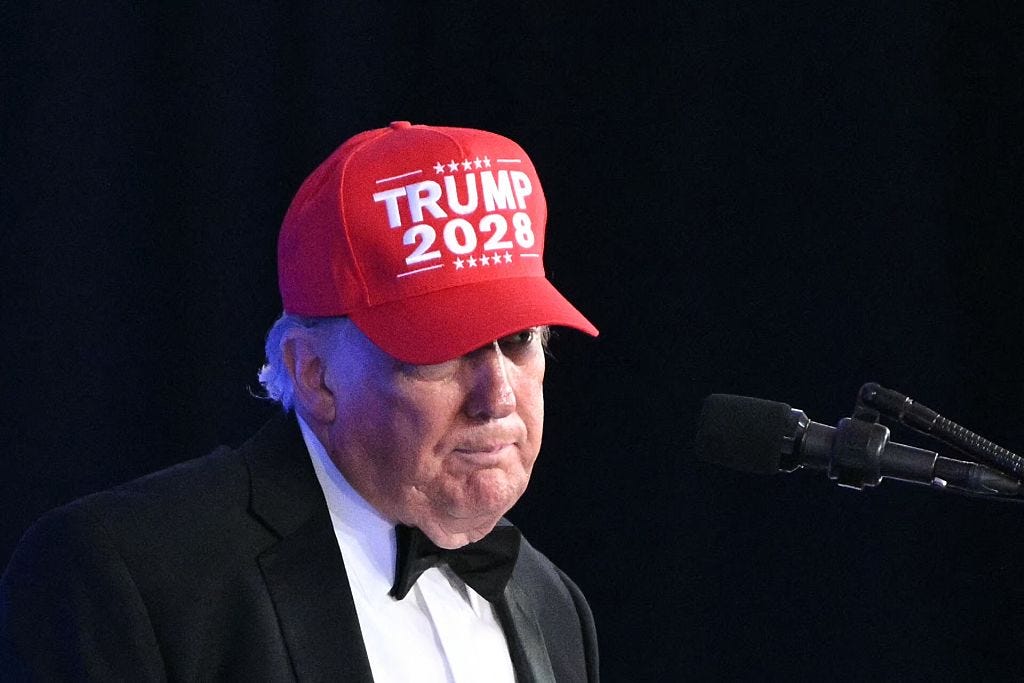
Wolf Blitzer stood at a podium inside the Presidential Ballroom of the Waldorf Astoria on Friday night, a few feet from the president, and told the White House correspondents' dinner what it has cost the Wall Street Journal to report that Donald Trump once sent Jeffrey Epstein a birthday letter. There's a $20 billion lawsuit, refiled in May after a judge tossed the first version. The suit put reporter Khadeeja Safdar's home address into a public filing, and her family had to move because of it. The paper's reporters are banned from Air Force One. Blitzer laid it all out, handed the Journal team the Katharine Graham Award for Courage and Accountability, and the room applauded the courage. Trump shook the winners' hands, mugging exaggerated shrugs as he did, and waited for his turn at the microphone.
You’ve probably read the rest: Trump’s speech was an hour of insults, and it flopped. CNN’s Brian Stelter says Trump “bombed” so thoroughly that he accidentally proved the dinner’s point. The Daily Beast went with “Humiliated.” And sure. The jokes were terrible. But I think these reviews are grading the wrong performance.
I wrote in April, after a gunman ended the first attempt at this dinner, that the correspondents’ association should let the whole thing end. They rescheduled it instead.

A performer bombs when he wants a room’s approval and can’t get it, and approval was never what Trump was there to collect. He already had what he needed from the press corps: attendance, a captive audience. It rescheduled its biggest night around him and sat him at the head table. What he wanted was the rest of it: the chance to stand in front of a profession he’s spent a year and a half suing, subpoenaing, banning, and defunding, insult it to its face for an hour on live television, and watch it hold still. He was there specifically for the silence.
Resist?
This is what standing up to Trump looked like on Friday night, according to the people who will defend the dinner.
The WHCA played a video featuring a computer-generated James Madison, who appeared onscreen to inform the room that “The government doesn’t get to shut the press up.” A living journalist saying that sentence into the microphone, to the president’s face, might have been a risk. A cartoon of a man who died in 1836 saying it is weak slop. AI-resurrected founders are usually a PragerU and Glenn Beck genre, the kind of thing I cover as right-wing propaganda. The press corps has now adopted the right’s format in its own defense. That’s roughly where we are.

There were awards, like the one Blitzer presented.
And there was Weijia Jiang, the outgoing WHCA president, opening the night with “We are back. We will not be intimidated.” She meant the gunman from April. But the man who intimidates the American press for a living? Sat beside her on the dais as her guest.
The genre’s well established by now. When Trump banned the AP from the Oval Office last year, the WHCA passed out “First Amendment” pins. At the April dinner, Jiang promised the press would keep covering this administration “whether you like it or not.” Pins and cartoons and toasts: okay.
When Trump announced in March that he’d attend, he posted that the correspondents had asked him to be “the Honoree” at their own dinner. They didn’t technically “honor” him, but if the association ever corrected him on that, I can’t find it. The right spent the weekend running its usual bit about how the press can dish it out but can’t take it. The truth is that taking it was all the press did. Politely, even.
Don’t say they weren’t warned
Days before the dinner, more than 500 retired and former journalists joined eight press freedom groups, the Committee to Protect Journalists among them, in an open letter telling the WHCA that celebrating the First Amendment “in front of the man who relentlessly attacks it” is hypocrisy.
Ten days before the dinner, Trump’s Justice Department was holding grand jury subpoenas over four New York Times reporters for their coverage of the Qatari jet, demanding testimony and phone records, including records belonging to their family members. The department pulled the subpoenas the day before the dinner, once a federal judge started asking whether the application contained perjury. The week before the dinner, Trump publicly called for revoking NBC’s and ABC’s broadcast licenses after they declined to carry his recent primetime address live. And back in November, the president declared that elected officials urging troops to refuse illegal orders had committed “SEDITIOUS BEHAVIOR, punishable by DEATH!” Does this sound like a man who respects the First Amendment?
And there’s no clean modern precedent for it. However, you can argue that John Adams jailing editors under the Sedition Act or Woodrow Wilson imprisoning dissenters under the Espionage Act are just as bad but different. The current attack on the press pulls every lever at once (the regulators, the courts, the licenses, the owners, the platforms, the money), and it’s how the United States just fell to 64th in the world on press freedom, its lowest ranking ever, in an index citing the defunded public broadcasters, the gutted Voice of America, and the detention and deportation of journalist Mario Guevara. Clayton Weimers, who runs Reporters Without Borders’ US office, skips the hedging entirely: Trump is “the single biggest threat to American press freedom today.”
The correspondents’ association read the letter and answered with a statement:
The White House Correspondents’ Dinner exists because the First Amendment matters most when it’s under pressure... our choice to gather as journalists, newsmakers and the president in the same room is a reminder of what a free press means to this country.
But gathering in that particular room was never the only option. The New York Times hasn’t bought a ticket to this thing since 2008, for reasons its former executive editor Dean Baquet once summed up: the dinner tells readers “we are all in it together and it is all a game.” The WHCA could have done any number of other things here. There was the awards-without-the-gala option, the no-invitation option, the no-thank-yous option. But no.
The letter called all this hypocritical. But Hypocrisy is a values problem. What the news business has with this president is an accounting problem.
For those who would like to financially support The Present Age on a non-Substack platform, please be aware that I also publish these pieces to my Patreon.
The price of a not-so-free press
So let’s do the books.
In December 2024, Disney paid Trump $15 million, plus another million in legal fees, over one sentence George Stephanopoulos said on the air. Meta paid $25 million to settle his deplatforming suit; X paid about $10 million for the same. Paramount paid $16 million over the editing of a 60 Minutes interview, and the FCC approved the company’s sale to Skydance just weeks later.
Then there’s YouTube. Google paid $24.5 million in September, and $22 million of it is earmarked for the White House ballroom. The fortified ballroom Trump spent part of Friday’s speech advertising, the one he suggested could host this dinner next year, is being built partly out of money a media company paid him to drop a lawsuit.
Paul Farhi ran the tally earlier this month: roughly $86 million from media and tech companies so far, spread across more than 30 defamation suits, exactly none of which Trump has ever won in court. He doesn’t need to win them. The filing of the lawsuits are themselves a show of force.
On the other hand, I’ve already explained what happens to journalists who publish stories Trump doesn’t like. That’s the menu every institution with a table at the Waldorf last Friday lives under: pay him, or bleed. Most of the owners paid.
Weija Jiang's statement actually made me laugh: "We are back, we will not be intimidated, we refuse to let an act of violence have the final word."
As if this self-important, superficial, elective social event were an act of bravado rather than a pompous conceit. Imagine thinking you're mustering courage and defiance against an act of violence by hosting a dinner in honor of the man who has brought so much violence to the world, to the economy, to our discourse, to our civil rights and even to the physical structure of the White House.
Her statement and this entire event are the perfect window onto our feckless, ossified national media.
"the United States just fell to 64th in the world on press freedom" should be a headline everywhere. Except, oh yeah, the lack of press freedom.