
The “Freakout” and the “Abyss”
When Texas Republicans gerrymandered at Trump’s direction, the Washington Post told readers to calm down. When Virginia Democrats responded, the editorial board found the end of democracy.

Hello! If you are reading this today, April 24, 2026, it is my 40th birthday! Want to get me a present? How about buying a paid subscription to The Present Age? Today only, it is 40% off here and over at my Patreon. Don’t pass up this deal!
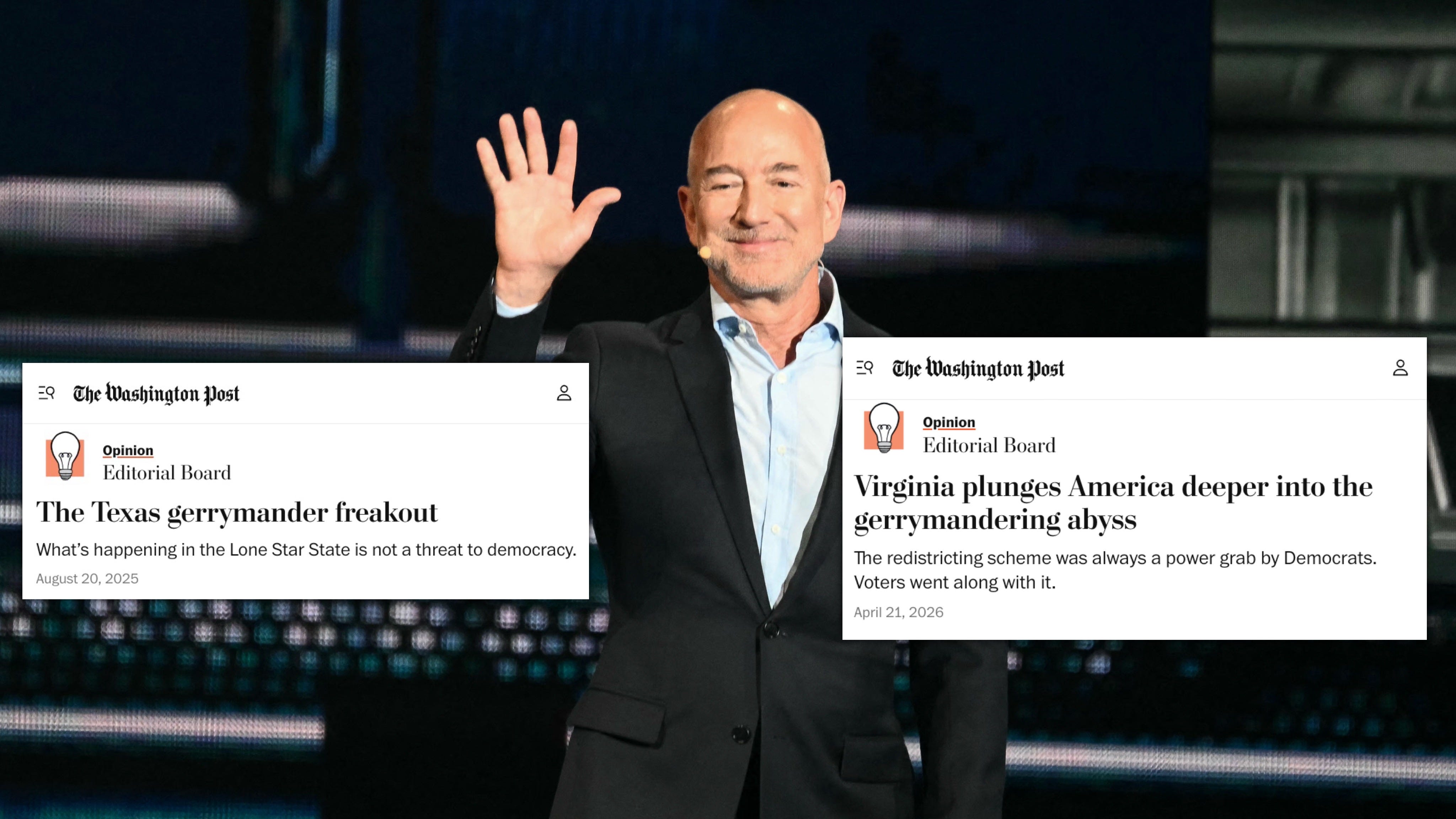
Eight months ago, The Washington Post‘s editorial board ran a piece called “The Texas gerrymander freakout.” The dek: “What’s happening in the Lone Star State is not a threat to democracy.” The occasion was Texas Republicans voting, at President Donald Trump’s explicit direction, to redraw the state’s congressional map mid-decade to pick up five House seats. The editorial called the move a “gambit” that might “prove shortsighted.”
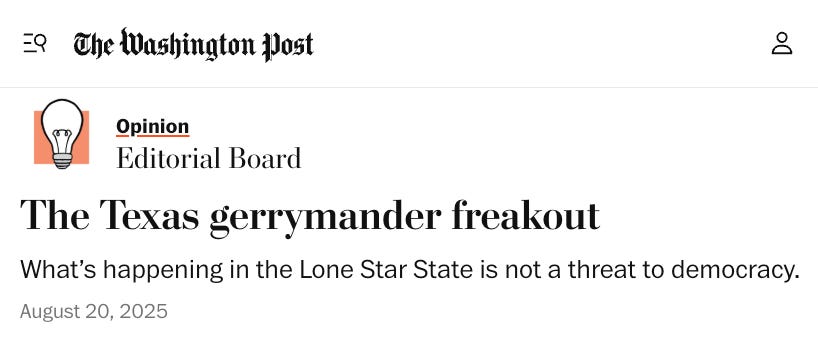
On Tuesday, the same editorial board ran a piece called “Virginia plunges America deeper into the gerrymandering abyss.” The dek: “The redistricting scheme was always a power grab by Democrats. Voters went along with it.” The occasion was Virginia voters narrowly approving a constitutional amendment that lets the Democratic-controlled legislature draw new congressional maps through 2030, a direct response to Republican mid-cycle gerrymanders in Texas, North Carolina, Ohio, and Missouri.
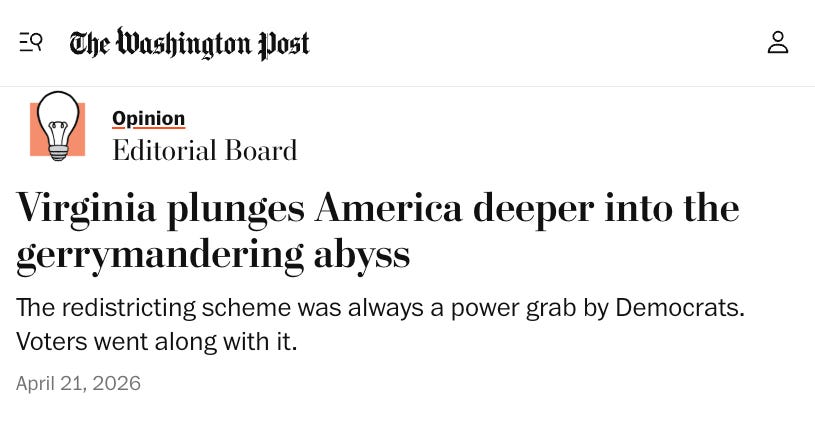
Same editorial board. Same paper. Same basic political action (one party redrawing a congressional map to gain House seats). Eight months apart.
The first one accused opponents of the move of having a “freakout.” The second one got an “abyss.”
What the Post is actually demanding
Here’s what that contrast amounts to when you pull the rhetoric off it.
The Post’s editorial board has decided that when Republicans rig a congressional map mid-decade at the direct instruction of the president, it’s politics. When Democrats respond by drawing their own map in states they control, it’s the end of democracy.
That position has a practical consequence most readers aren’t being asked to notice: it tells Democrats to unilaterally disarm.
To be clear: I think partisan gerrymandering should be outlawed. Nationally. And Democrats have been trying to do exactly that for years, only to be blocked by Republicans. That’s still the Democratic position.
Republicans have refused to pass a federal ban on partisan gerrymandering. They’ve then, under Trump, run mid-cycle redraws in several states to gain House seats. Telling Democrats they can’t respond to that with their own maps, in states they control, is telling them to play by rules only one side is following. It’s a demand with a partisan outcome baked into it.
The Post’s editorial board is free to take the position that Democrats should roll over anyway. What it can’t do is pretend that position is obvious, neutral, or grounded in concern for democracy. It’s a partisan stance that happens to favor Republicans, who seem to get a pass when it comes to trying to use gerrymandering to keep control of the House.
I’ve written before about what’s happened to the Post under Jeff Bezos, and I won’t redo that case here. Other people have clocked the Texas-Virginia contrast already. Democracy Docket ran a piece this week making roughly the argument I just made. What I want to do in the rest of this piece is something they didn’t: look at how the editorial board sells that partisan demand to its readers, sentence by sentence.
How the same thing becomes two different stories
Start with the words.
Here’s how the Texas editorial described Republicans redrawing a congressional map at Trump’s explicit instruction, mid-decade, to gain five House seats: “Partisan gerrymandering is never pretty, no matter which side is doing it, but hold the apocalyptic warnings about the end of democracy. Republicans’ gambit could well prove shortsighted.” The piece called the redraw “not pretty,” a “gambit,” but potentially “shortsighted.” It described the broader situation as “Texas’s antics” and assured readers the redistricting wars “will not put American democracy on life support.”
Here’s how the Virginia editorial described Democrats passing a referendum: “For months, Democrats crafted the illusion that their plan to redistrict Virginia was about restoring ‘fairness.’ In a special election on Tuesday, most voters assented to that deception as a referendum to rewrite the state constitution narrowly passed.” Democrats were “disenfranchising Republican voters.” The referendum was a “power grab,” a “cynical calculation,” a “race to the bottom” into an “abyss.” Democrats were offering “false sanctimony about democratic norms.”
The Texas editorial mostly describes events rather than actors. Texas “is breaking” the norm of waiting for post-census data. “The Lone Star State’s changes are not happening in a vacuum.” And the editorial’s most revealing sentence, about the Justice Department’s racial-gerrymander pretext for the redraw: “This Justice Department notice serves President Donald Trump’s political agenda for the 2026 midterm elections, but that does not mean it’s frivolous.”
The Post conceded the DOJ’s motive in the first half of that sentence and endorsed its legitimacy in the second. It named the causation and asked readers to look past it.
The Virginia editorial reads differently. Democrats “crafted the illusion.” Democrats made “a cynical calculation.” Voters “assented to that deception.” The verbs are active, the subject is the party, and the charge is moral.
The same asymmetry shows up in who gets named.
Trump appears in the Texas editorial three times, all neutrally: “Trump’s political agenda,” “territory Trump won by double digits,” “the last two years of Trump’s presidency.” He is never, in that editorial, identified as the person who directed Texas Republicans to redraw the map. The Post’s own news reporting confirms he did. The editorial board didn’t.
The Virginia editorial names Barack Obama. “Democratic leaders have long fancied themselves as champions of democracy and fair elections,” the editorial says. “But many of these politicians, including former president Barack Obama, made a more cynical calculation in Virginia.”
The Trump-directed Texas gerrymander has no named agent. The Obama-endorsed Virginia referendum response gets Barack Obama, by name, accused of cynicism.
Then there’s what the Virginia editorial did with Tim Kaine.
Kaine, as quoted in the editorial, said this about Virginia’s congressional Republicans:
“In 2021, all five Republicans in Virginia went along with Donald Trump in his effort to overturn election results. And so we’re giving Virginians a chance to vote — which Republican states have not done — about whether they want to have a congressional delegation that will stand up against Donald Trump’s tyranny if he tries to interfere with our elections.”
He is talking about January 6. About Virginia Republicans going along with Trump’s effort to overturn the 2020 election. He is saying voters should have the chance to decide whether their congressional delegation will stand up to Trump next time.
The Post’s editorial board responded:
“Virginia voters already had two chances to judge those Republican candidates — in 2022 and again two years later — and decided to keep them in office. Kaine disagreed with the people’s verdicts and supports overturning those results, to borrow his own terminology, by reworking the map.”
The Post took Kaine’s language about Republicans trying to overturn a presidential election and used it to accuse Kaine of trying to overturn election results, which is absolutely not what this is.
The paper that broke Watergate published a sentence equating support for a redistricting scheme that both sides had engaged in with complicity in a coup attempt.
What “disenfranchising” means now
The word is disenfranchising. The Post used it in the Virginia editorial to describe Democrats drawing a congressional map. Democrats, the editorial said, are “disenfranchising Republican voters.”
That word has a specific history in American politics. It describes voter roll purges. Poll taxes. Literacy tests. Voter ID laws that disproportionately affect Black voters. Proof-of-citizenship requirements that block millions of eligible Americans from registering. In 2025 alone, at least 17 states passed 32 new restrictive voting laws, most of which will be in effect for the 2026 midterms. That is what “disenfranchisement” is.
None of that is what happened in Virginia. Republican voters in Virginia will vote in 2026. Nobody is being removed from the rolls. Nobody is being required to produce documents they don’t have. Nobody is being turned away from a polling place. A new congressional map, drawn by the legislature voters elected, will change which candidates those votes help elect. That is what redistricting does, in every state, every decade, for both parties.
The word is doing something. It’s taking a political outcome (Republican voters electing fewer representatives than they’d like) and relabeling it as a civil rights violation. It’s dressing a partisan loss in the clothes of voter suppression.
That move fits a specific project. In February 2025, Jeff Bezos narrowed the Post’s opinion section to the defense of “personal liberties and free markets.” In my earlier piece on that announcement, I noted that when billionaires use that phrase, they tend to mean their own liberty: freedom from taxation, freedom from regulation. Not yours. The Virginia editorial completes the circuit. A congressional map Democrats drew in response to Republicans’ own mid-cycle gerrymanders becomes, in the editorial’s language, a violation of liberty. Republican liberty, specifically.
The editorial page Bezos paid for
In late October 2025, David Folkenflik at NPR reported that over a two-week stretch, the Post editorial board had published three editorials on matters where its owner had undisclosed financial interests. One defended Trump’s demolition of the East Wing for a new ballroom; Amazon was a donor to the project. One argued for new small nuclear reactors; Bezos has a stake in a Canadian fusion venture. One urged D.C. to fast-track self-driving car approvals; Amazon’s Zoox had just announced D.C. as its next market. None of the editorials disclosed the conflict.
The gerrymander editorials are about democracy. That is the one subject the Post built its brand around. For nearly a decade, the Post has run “Democracy Dies in Darkness” on its front page. Now the editorial page looks at a Trump-directed mid-cycle redraw and calls it a “gambit,” and looks at a voter-approved Democratic response and calls it an “abyss.”
The Virginia editorial isn’t hiding this. “They’re right that the GOP started this fight by trying to pick up five House seats in Texas through gerrymandering,” it reads, “but they can spare us the false sanctimony about democratic norms going forward.” The editorial board knows what happened. It wrote the piece anyway.
“None of this was necessary,” the Virginia editorial concluded. That’s true. None of it was. Not the Texas redraw, not California’s response, not Virginia’s. The editorial board used that sentence against Virginia voters who passed a referendum. It didn’t use it against Texas Republicans who redrew a map on Trump’s orders. Their only concern at the time was that Texas might be narrowing the margins too much and might overplay their hand.
At this point the Washington Post is essentially an Amazon newsletter.
Happy birthday, Parker! Enjoy the birthday weekend.