


Today, the International Olympic Committee adopted a new policy on who gets to compete as a woman at the Olympics. Here’s how the press covered it:
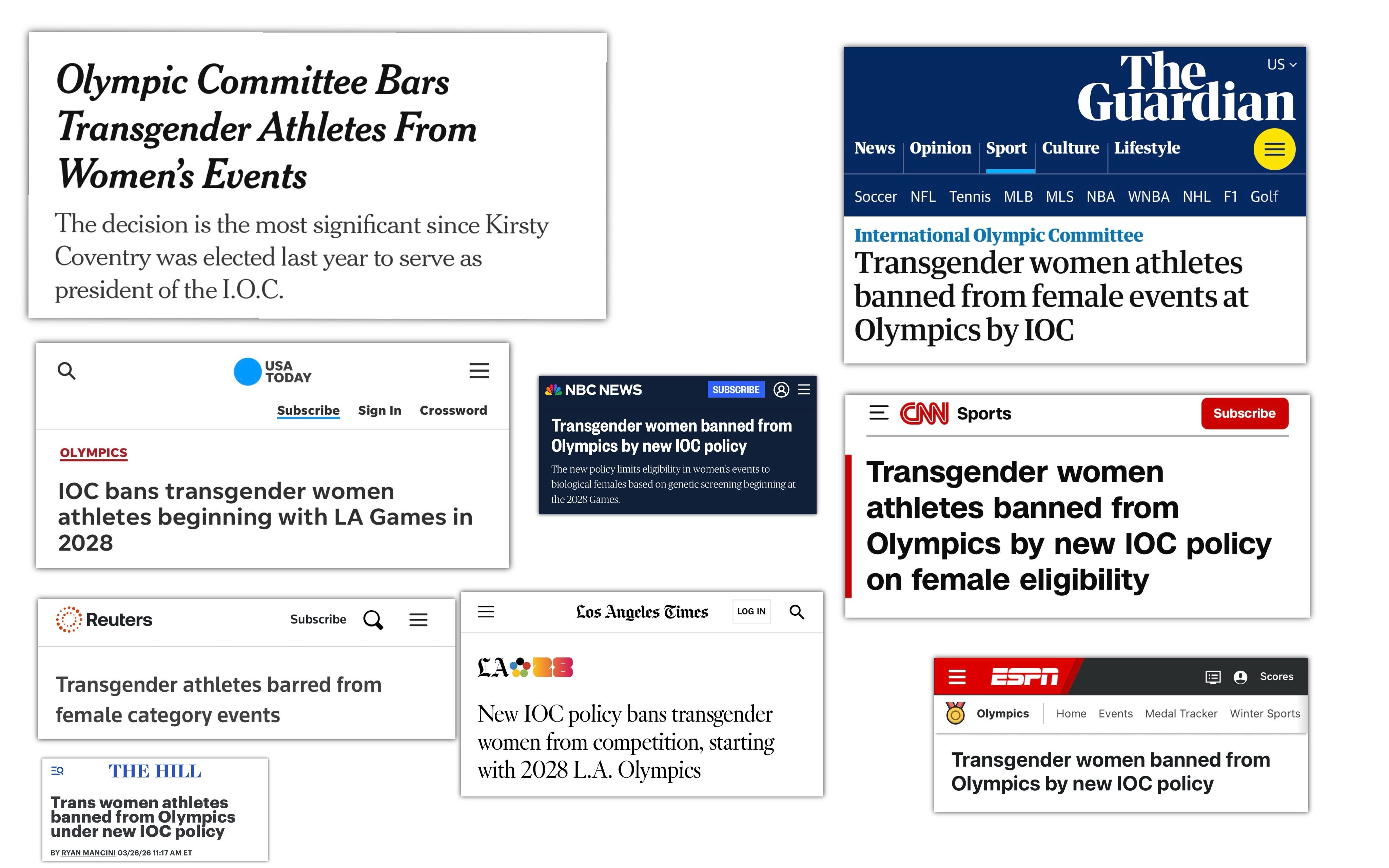
You get the idea. Buried further down, the AP wire story that most of these outlets ran mentions that the policy “also restricts female athletes such as two-time Olympic champion runner Caster Semenya with medical conditions known as differences in sex development, or DSD.”
Also.
Caster Semenya is a cis woman. She was female at birth, raised as a girl, and identifies as a woman. She won two Olympic gold medals in the 800 meters. And in the AP’s framing, the fact that this policy will exclude her from competition is an afterthought, tacked on below paragraphs about trans athletes.
The IOC’s new policy requires all female athletes to undergo SRY gene screening, a one-time genetic test, to compete in women’s events starting at the 2028 Los Angeles Games. The athletes who will actually be flagged by this test are overwhelmingly women like Semenya: cis women with differences in sex development. By leading every story with “trans ban,” coverage is taking a situation that affects other women and jamming it into a culture-war frame that doesn’t really fit.
It’s easy to see why it happened. Trans athletes are a political lightning rod. DSD is a complicated medical topic most people have never heard of. Editors know which one gets clicks. So a DSD story becomes a trans story, and the women it’s actually about disappear.
That framing does a disservice to everyone. It does a disservice to women with DSDs, whose specific situations get flattened into someone else’s political fight. It does a disservice to trans people, whose lives and rights get reduced to a sports debate that, at the Olympic level, barely involves them. And it does a disservice to anyone reading the news today and thinking they understand what the IOC just did. When you frame a DSD story as a trans story, nobody ends up better informed about either one.
I’ve been writing about this exact conflation since 2019. The Paris boxing controversy that actually catalyzed this policy wasn’t even about trans women. Neither Imane Khelif nor Lin Yu-ting is trans. Lin Yu-ting already passed her SRY gene test and isn’t affected by this policy at all. The framing hasn’t changed.
Whether the IOC should ban trans women from Olympic competition is its own question. I’m setting it aside here, because this piece is about the people who are being erased from the conversation.
Let’s look at the actual numbers
Trans women have been eligible to compete in the Olympics since 2004. In the 20-plus years since, nearly 30,000 women have competed at the Summer Games. Of those exactly one was trans: weightlifter Laurel Hubbard, who didn’t finish her event at Tokyo in 2021. No trans woman competed in Paris. The AP’s own coverage of today’s policy acknowledges that “it is unclear how many, if any, transgender women are competing at an Olympic level.”
That’s 0.0034%.
Now look at the other side. World Athletics has acknowledged that certain DSDs are roughly 140 times more prevalent among elite female athletes than in the general population, so even if you start breaking down just how rare individual conditions are, they’re more likely to show up in athletes. We don’t know exactly how many women the IOC’s new screening will flag, but we have a pretty good idea of the scale. At the 2016 Rio Olympics, the entire women’s 800 meter podium consisted of athletes with DSDs: Semenya took gold, Francine Niyonsaba of Burundi won silver, and Margaret Wambui of Kenya earned bronze.
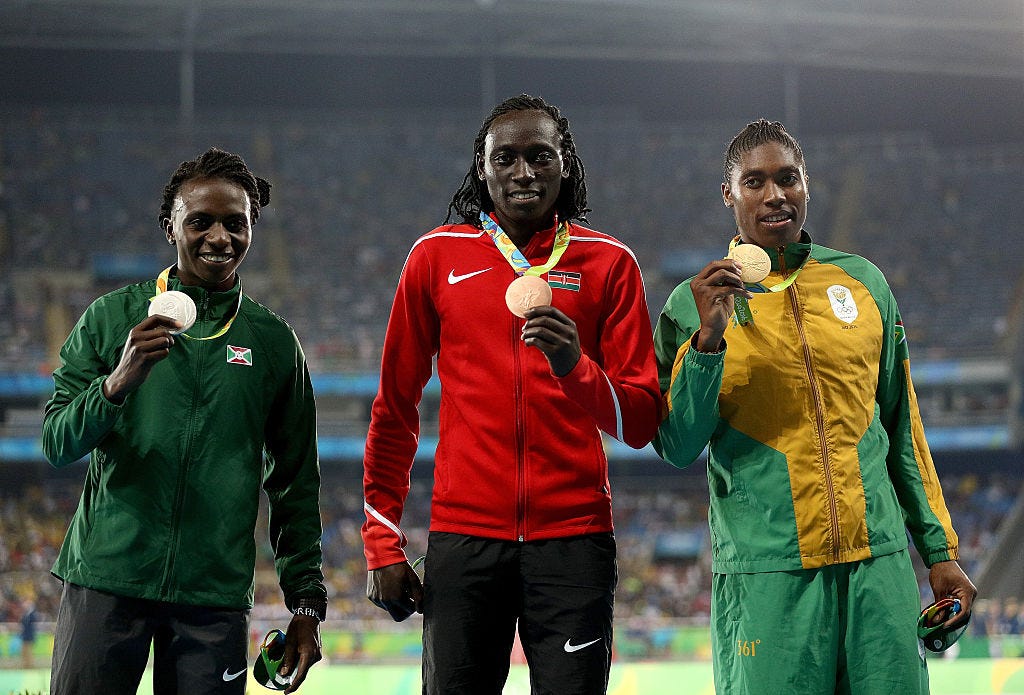
One trans woman in two decades. A full Olympic podium of DSD athletes at a single Games. The headlines went with the first story.
If determining the specific eligibility requirements when it comes to women with certain DSDs is something the IOC wants to tackle, there’s a very nuanced discussion to be had there. But by tacking all of this onto something related to trans athletes, they can safely implement a pretty sweeping ban and flatten the conversation so that the public goes, “Well, that’s just common sense.” It does those women a disservice.
So who are the women in the “also”?
DSD stands for differences in sex development. These are rare conditions where someone’s chromosomal, gonadal, or anatomical sex develops atypically. In practice, the athletes affected by the IOC’s new policy are mostly women who have XY chromosomes but whose bodies developed in ways those chromosomes wouldn’t predict. They were raised as girls. They are women. Many of them didn’t know anything was atypical about their biology until someone in sports administration decided to test them.
Semenya responded to today’s policy by calling it “exclusion with a new name.” She told the New York Times: “I have carried this weight. So have other women of color who deserved better from sport. Reintroducing genetic screening is not progress — it is walking backward.” She’s been barred from her best event since 2019 under World Athletics testosterone rules. Niyonsaba has said she won’t undergo hormone suppression. Khelif, the Algerian boxer who won gold in Paris while half the world called her a man (she isn’t one), says she’ll take the SRY test.
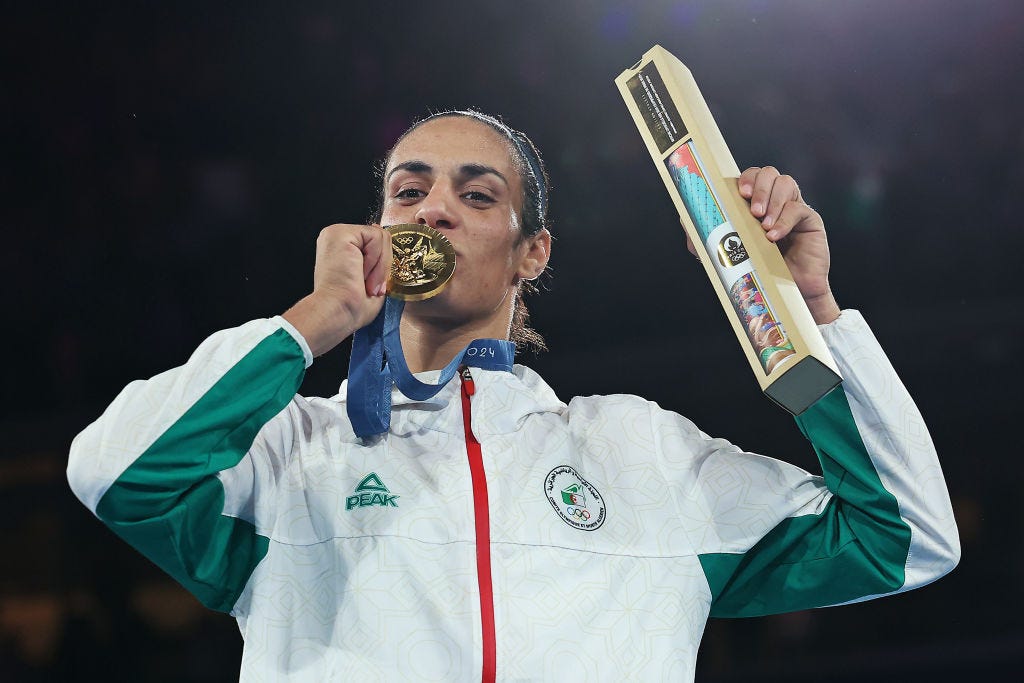
Look at those names and nationalities. South Africa, Burundi, Kenya, Algeria. Add Dutee Chand (India) and Santhi Soundarajan (India) and Pratima Gaonkar (India). The women who get publicly subjected to eligibility disputes are overwhelmingly women of color from the Global South. Semenya named it herself: other women of color who deserved better from sport. That pattern doesn’t get examined when every story is framed specifically around trans women.
The IOC’s policy document includes provisions for mental health support, counseling, and informed consent for athletes who screen positive. That language is in there because the IOC knows what this process can do to a person. The history tells you why they know.
In October 2001, Pratima Gaonkar was an 18-year-old sprinter and swimmer from a tiny village in South Goa. She’d just won a silver medal in the 4×400 relay at the Junior Asian Athletics Championships in Brunei. She was the financial “hope of her family,” which survived on her mother’s intermittent income as a farm hand making 15 rupees a day. Three months after that silver medal, her brother Shivanand overheard a phone conversation between Pratima and her coach. “She said, ‘sir, you can’t do this,’” he told the Indian Express years later. “Then she hung up and began sobbing.”
The next day, Pratima’s body was found in a village well. She had tied bags of stones to her ankles. She was a swimmer. She wanted to make sure her instincts wouldn’t stop her from drowning.
After her death, local newspapers published details from her post-mortem on their front pages, including descriptions of her private parts. Her mother, Jayashri, told the Indian Express: “We never spoke about her physical characteristics after she turned 13-14. And she looked like any other girl and behaved like a girl. I am not an expert in science or medicine to advise my daughter about hormonal changes.”
She was 18.
Santhi Soundarajan, an Indian runner who won silver in the 800 meters at the 2006 Asian Games, was forced to take a sex verification test less than 24 hours after her win. She was stripped of her medal. She later said she’d been made to sign papers in English, a language she doesn’t understand. She attempted suicide. For a time, she worked as a laborer in a brick kiln. These sorts of unexpected results can upend lives.
Some things the coverage isn’t getting to
When the framing is “trans ban,” certain questions don’t get asked.
The IOC already tried mandatory sex testing. For decades, every female Olympic athlete was screened. In all those years of testing, it never caught a single person deliberately misrepresenting their sex. What it did do was destroy the careers and lives of women with intersex conditions they didn’t know they had. The IOC walked away from the practice. Now it’s back with a different test, but the basic setup is the same: mandatory genetic screening that will primarily flag cis women.
The IOC didn’t publish any new research with this policy. The working group “reviewed the state of the science” and “reached consensus,” but the science on testosterone and athletic performance has been in the literature for years. IOC President Kirsty Coventry called the policy “based on science and led by medical experts.” What’s new here is the policy decision. The science didn’t change.
The policy itself is less straightforward than the headlines suggest, too. The IOC carved out an exception for athletes with Complete Androgen Insensitivity Syndrome (CAIS), a condition where someone has XY chromosomes but whose body doesn’t respond to testosterone at all. Those athletes can still compete as women. Which means the IOC itself recognizes that testing positive for the SRY gene isn’t a simple pass/fail. Biology is messy, and the IOC knows it. But you wouldn’t get that from coverage that treats the whole thing as a binary question with a binary answer.
And then there’s the trickle-down problem. The IOC’s policy document says this doesn’t apply to grassroots or recreational sports. But the document also tells international federations they “shall” adopt the policy and “strongly recommends” screening athletes early in their careers. I’ve written before about how elite-competition rules get picked up by state legislators and school boards who don’t read the fine print. They read the headline. And the headline says “transgender women banned.”
That trickle-down will hurt cis girls and women with DSDs entering sport at every level, and it will hurt trans girls, too. The IOC document claims that male athletic advantage stems partly from testosterone exposure “in utero” and “in mini-puberty of infancy,” but doesn’t cite any evidence for that specific claim. If a school district adopts that reasoning, it becomes a justification for banning a trans girl who went on puberty blockers at 10 and never went through male puberty at all. Sure, the IOC isn’t asking anyone to do that. But it doesn’t have to.
Ugh. At first I was just furious as usual that the trans community was being picked on, again, for something that is not in any way a problem. But now I have something else to be upset about. Fuck the IOC. No one should watch the Olympics they don't give a shit about the athletes!
Thank you Parker. Your accurate analysis and context on this conflated news story helped me and reduced the stinging. It just sucks. I love the Olympic Games and what they stand for. My heart goes out to the athletes and people this will affect.