


Federal agents arrested Don Lemon late Thursday night at a Beverly Hills hotel. He’d been in Los Angeles to cover the Grammy Awards.
The charges connect to January 18, when Lemon covered an anti-ICE protest at Cities Church in St. Paul, Minnesota. Protesters had gathered there after learning that one of the church’s pastors, David Easterwood, serves as the acting field director of the local ICE field office. They entered during a service, chanting “Justice for Renée Good” and “ICE out.”
Lemon, a journalist for 30 years, was there with a camera. He documented the protest. He interviewed people on multiple sides of it, including the pastor. In video he posted to Instagram, he said: “We’re not part of the activists, but we’re here just reporting on them.”
For this, he’s now facing two federal charges: conspiracy to deprive civil rights and violation of the FACE Act (the Freedom of Access to Clinic Entrances Act, which also covers houses of worship). The Department of Homeland Security announced the charges Friday morning.
Three others were arrested in connection with the same protest: Trahern Jeen Crews, Jamael Lydell Lundy, and Georgia Fort. Fort is an Emmy-winning Minnesota journalist and vice president of the state chapter of the National Association of Black Journalists. She livestreamed federal agents arriving at her home early Friday. “This is all stemming from the fact that I filmed a protest as a member of the media,” she said before surrendering.
Attorney General Pam Bondi announced the arrests on X: “At my direction, early this morning federal agents arrested Don Lemon, Trahern Jeen Crews, Georgia Fort, and Jamael Lydell Lundy, in connection with the coordinated attack on Cities Church in St. Paul, Minnesota.”
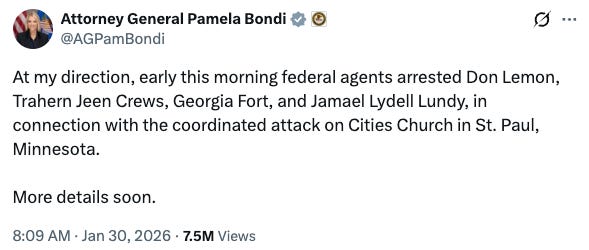
A “coordinated attack.” That’s what we’re calling it?.
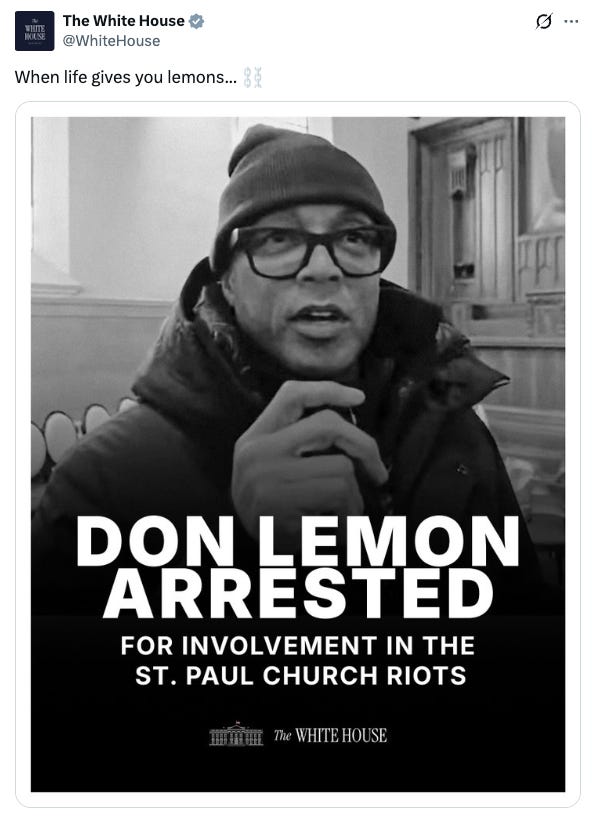
And then came the victory lap. The official White House account posted a photo of Lemon with the text “DON LEMON ARRESTED FOR INVOLVEMENT IN THE ST. PAUL CHURCH RIOTS” and the caption “When life gives you lemons...” followed by a chains emoji.
Real subtle, guys.
The judges said no
This wasn’t the government’s first attempt to charge Lemon.
Last week, federal prosecutors sought arrest warrants for Lemon and several others connected to the January 18 protest. Magistrate Judge Douglas Micko rejected the request, finding that prosecutors had failed to present sufficient evidence.
Then came an even more pointed rebuke. Minnesota’s Chief U.S. District Judge Patrick Schiltz wrote to the 8th Circuit Court of Appeals that Lemon and his producer were “not protesters at all,” and that “[t]here is no evidence that those two engaged in any criminal behavior or conspired to do so.”
The appeals court declined to compel the lower court to sign the arrest warrants.
Two courts. Two rejections. You might think that would be the end of it.
A source familiar with the matter told ABC News that Bondi was “enraged” by the magistrate’s decision.
So the Justice Department went around the judges. They took the case to a grand jury.
CNN noted in a statement defending its former employee that the DOJ “already failed twice to get an arrest warrant for Don and several other journalists in Minnesota, where a chief judge of the Minnesota Federal District Court found there was ‘no evidence’ that there was any criminal behavior involved in their work.”
When federal judges tell you there’s no evidence of a crime, and your response is to keep trying until you find someone who’ll say yes, that tells you everything about what this prosecution is actually about.
What they were protesting
I’ve been writing about Minneapolis for the past couple of weeks, so I won’t rehash everything here. But some quick context:
Renee Good was 37. A poet. A mother. On January 7, ICE agent Jonathan Ross shot and killed her as she sat in her car. Video shows her turning to drive away when he fired.
Alex Pretti was also 37. An ICU nurse who spent his career caring for veterans. On January 24, Border Patrol agents shot and killed him while he stood at a protest holding his phone. He had a legally permitted firearm that agents removed from his holster before they opened fire.
Both were U.S. citizens. The agents who killed them have faced no charges.
Meanwhile, Minnesota’s chief federal judge found that ICE has violated at least 96 court orders in the state since January 1. Governor Tim Walz has called the federal presence a “campaign of organized brutality.”
That’s why people showed up at Cities Church. That’s what Don Lemon was there to cover.
Enter the wrong question
Within hours of Lemon’s arrest, Chris Cillizza posted on social media: “A few days ago, I wrote a big piece asking this question: Is Don Lemon a journalist? In light of his arrest, I think it’s worth reading.”
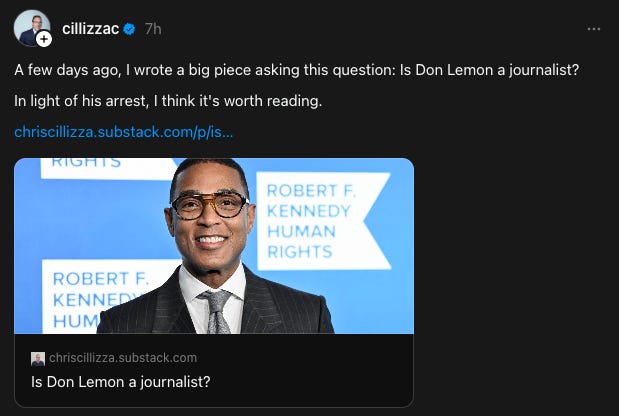
In light of his arrest. A journalist is sitting in federal custody after the courts found no evidence of criminal conduct, and Cillizza thinks this is a good time to revisit whether the guy has the right credentials.
The piece itself is a long meditation on how journalism has changed since the gatekeeping era. The internet democratized media, anyone can call themselves a journalist now, there are no agreed-upon standards anymore. You know the drill.
Cillizza notes that Lemon has a “VERY clear lean to his work” and cites some of his Substack headlines as evidence: “Donald Trump Is An International JOKE!” and “Watch Donald Trump Unravel On Live TV!” He groups Lemon alongside Ben Shapiro, Pod Save America, and The Gateway Pundit as examples of people whose journalism credentials are questionable.
To his credit, Cillizza does include this: “Don absolutely should not have been charged in this instance.”
One sentence. Buried in a piece that otherwise spends a hundreds of words wondering aloud whether Lemon really belongs in the journalism club.
Here’s what Cillizza frames as the central question: “what makes someone a journalist versus an activist?” He says he doesn’t know the answer, that he “struggle[s]” with it, that these are hard questions for our changing media landscape.
But there’s a problem with treating this as an interesting thought experiment right now. The Department of Justice is making the exact same argument. Their entire legal theory depends on the claim that Lemon wasn’t acting as a journalist when he entered that church. That’s why they’re charging him under conspiracy and FACE Act statutes instead of acknowledging that he was a reporter documenting a newsworthy event.
Federal judges looked at the evidence and concluded Lemon was doing journalism. Cillizza looked at his Substack headlines and isn’t so sure.
What Lemon actually did that day
Cillizza’s piece conflates two very different things. There’s Don Lemon’s overall body of work: his YouTube show, his Substack, his social media presence, his obvious contempt for Donald Trump. And then there’s what Don Lemon did on January 18, which was show up to a story, film it, and talk to the people involved.
That second thing is journalism. Basic, straightforward journalism.