

Out of everything at Trump’s White House UFC party this weekend, the thing I keep coming back to is the Bud Light logo on the cage.
Plenty of people clocked it and got confused. Wasn’t that the woke beer? Didn’t conservatives spend the better part of 2023 shooting cases of it in the backyard?
So there was the usual round of takes. One treated the logo as proof that the outrage was always hollow, that culture-war anger has the shelf life of a gas station sandwich and nobody really means it. Another just called it hypocrisy.
I think both of those miss what actually happened and what Bud Light represents.
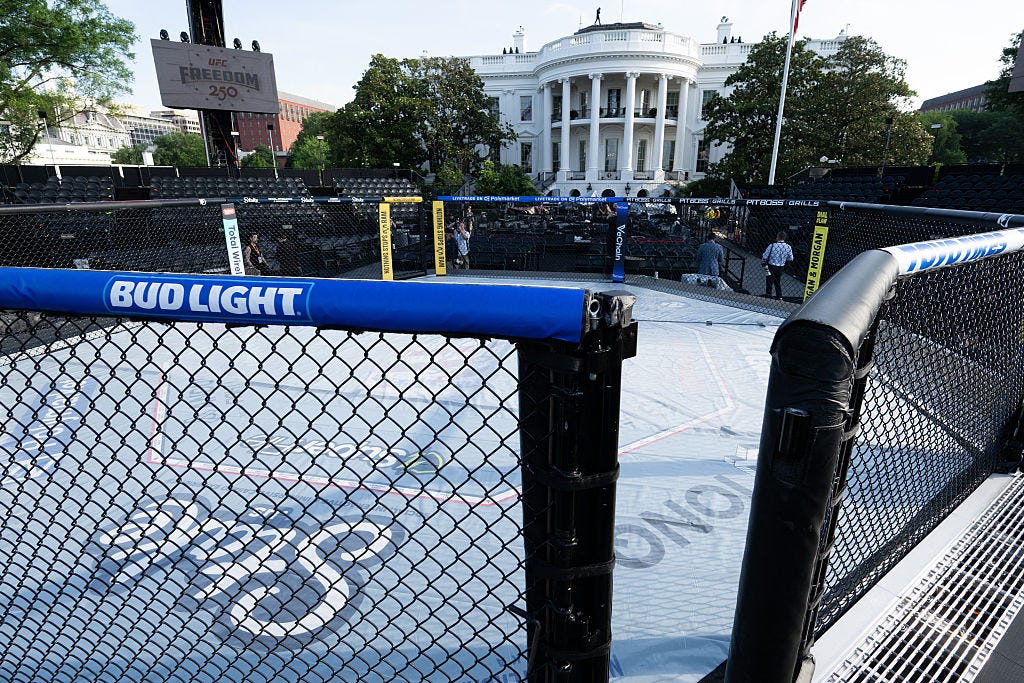
Yes, the logo’s there because Bud Light is UFC’s official beer, so at first glance it’s just one more logo at one more event. When Dana White got asked in 2023 about doing business with a company the right had spent months torching, he shrugged on Hannity that you take sponsorships “for the money.” Fine. And yet the same drink the right turned into the single most radioactive brand in the country is now the official beer of the most MAGA-coded sport in America, appearing in the octagon at the president’s birthday party, with not one Republican throwing a fit about it.
Why? It’s simple: They won.
The logo on that cage is the trophy. Bud Light handed over everything the right asked for in 2023. The company transformed its marketing strategy in the wake of the backlash and Trump’s eventual reelection. Out were sponsored posts on a transgender microcelebrity’s Instagram page. In came bid dollar deals with the UFC and Super Bowl ads. They relentlessly targeted and pandered to conservatives and successfully got back in the right’s good graces.
And calling it hypocrisy misunderstands the slogan they run on. “Go woke, go broke” is a threat dressed up as a market prediction. The right doesn’t sit back and wait for shoppers to punish a woke company; its influencers and politicians and pressure groups go do the punishing themselves. Bud Light is where they showed they could, and every other brand in the country got the message: this could be you. Don’t anger us. Bend the knee.
Let’s remember the Bud Light backlash
In April 2023, Bud Light sent Dylan Mulvaney a custom can with her face on it for a sponsored Instagram post marking a year of her transition.
This was about as small as a brand deal gets. One paid post, on Mulvaney’s own Instagram, made for the fans already following her, the kind of thing influencers sign every day of the week. Bud Light wasn’t putting her on television or making her the face of the brand. Bud Light had likely partnered with dozens if not hundreds of influencers to advertise to their own niche audiences.
It's worth getting specific about what she actually did to set off the backlash Did she say something bigoted? No. Was her content cruel, or gross, or even edgy? No. Her whole catalog was personal vlogs and day-in-the-life videos, about as harmless as online content gets. And a good chunk of the country looked at that and nodded: yep, the brand blew it by, uh, paying a trans woman to post about a beer. It'd be one thing if she were some provocateur firing off inflammatory takes all day. She wasn't. She filmed her life. The boycott needed her to have done something, and she hadn't. So being a trans woman in public had to be enough.
There was nothing she’d done. The fury was about who she is. The fury was about being angry that this company would try to advertise specifically to her audience.
The company folded hard.
Two weeks in, CEO Brendan Whitworth released a statement that managed to never say Mulvaney’s name and never defend her. “We never intended to be part of a discussion that divides people,” he offered, which is a strange thing to say about mailing someone a novelty beer can. Soon enough, Anheuser-Busch had pushed several executives out the door, including the Bud Light marketing VP who’d approved the partnership. (After that executive moved on to another job, some right-wing media outlets tried to get the outrage machine running again to drive her out of that, too.) The warning to anyone else on the payroll was easy to read: get near the wrong person and you’re the one who goes.
Modelo Especial overtook Bud Light as the best-selling beer in America, ending a run at the top that had lasted about two decades. Sales fell by nearly 30 percent year over year. That July, the company laid off around 380 U.S. workers. By the time the year was out, the boycott had cost Anheuser-Busch as much as $1.4 billion in North American sales.
Through all of it, Bud Light never once stood up for the person it had partnered with. It sidelined the marketers, went quiet, absorbed the losses, and waited for the weather to change. The whole plan was to make Dylan Mulvaney vanish from the story as fast as possible.

Going quiet was only half of it. Bud Light also chased the customers it had lost. That October, with the boycott still biting, it took the UFC sponsorship back from Modelo, the brand that had just passed it, and leaned hard into its American roots and its support for veterans and first responders. It paid off.
The welcome started at the top. In February 2024, with Bud Light’s sales still down, Trump asked his supporters on Truth Social to give the brand a “second chance,” telling them it wasn’t really a woke company after all.
Dylan Mulvaney named what the racket was for before most people did. She had gone quiet for months, scared to leave her house. Then she spoke about Bud Light directly. “For a company to hire a trans person and then not publicly stand by them is worse, in my opinion, than not hiring a trans person at all,” she said, “because it gives customers permission to be as transphobic and hateful as they want.” The silence taught every company watching that the safe move is to cut the trans person loose and walk away. But Mulvaney was looking past the boardrooms. The hate, she said, doesn’t end with her. It has “serious and grave consequences for the rest of our community.” She was right.

 Tiktok failed to load.
Enable 3rd party cookies or use another browser
The lesson everyone else took
Back when the boycott was still raging, I wrote that the point was to make companies think twice before hiring a trans person for any role at any level, and that it already seemed to be working. It’s working.
This goes well beyond one beer, or even beyond trans people. The same machine swings at anything it can tag as “woke,” big or small, serious or silly: Cracker Barrel’s redesigned logo (Trump told them to change it back, and they did), Bad Bunny’s Super Bowl booking (the president called a Spanish-language halftime show a slap in the face to the country), a brief kiss between two women in a Pixar movie, Pride night at Dodger Stadium. Most people can let a movie or a halftime show that isn’t aimed at them go by. This crowd can’t. This crowd needs everything to be centered around itself. The whole project is to bend the culture to their liking and crowd everyone else out.

Point that machine at trans people and the results stack up fast. Building on the Bud Light backlash, right-wing activist Robby Starbuck turned the boycott into a business model, running one campaign after another until, by early 2025, he was claiming credit for getting more than a dozen major companies to drop their diversity and LGBTQ programs.
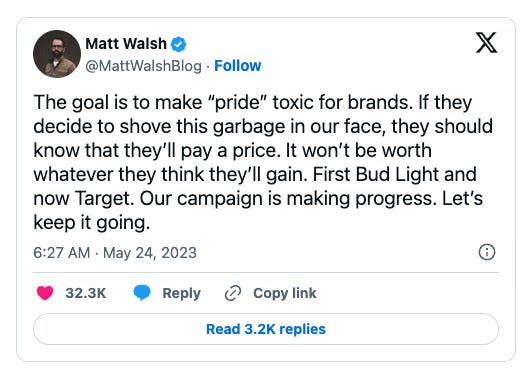
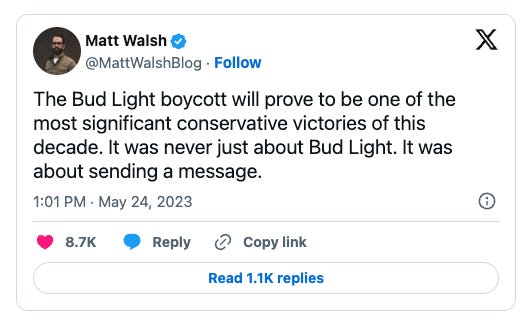
The corporate Pride money that used to flow every June started to evaporate. NYC Pride came up $750,000 short in 2025 as longtime sponsors slipped away, and Target gutted its diversity commitments. Matt Walsh, one of the loudest voices behind these boycotts, said the goal was to make “pride” toxic for brands. Well, congrats, Matt. I guess?
No need for a smoke-filled room. One company got made an example of, the punishment was loud, the reward was real, and every other company drew the obvious conclusion. That’s all it takes: one cautionary tale and a long memory.
The public face
All of that is the view from the boardroom. Here’s what it costs on the other side.
Laverne Cox was on the cover of Time in 2014, the face of what the magazine called “the transgender tipping point.” This month, promoting a memoir, she took stock of what the backlash has cost her. “I’ve lost so much money because of this administration, the past year,” she told Attitude. She’d stayed busy with acting and branding, she said, but “never thought college speaking gigs would dry up.” By her own estimate, the lost work came to around 90 percent of her income. The reason she gave is the one behind all of it: “This administration is very punitive with anything that suggests ‘DEI’ or ‘gender ideology,’ and corporations have been very scared.”
Your first thought might be to write this off as celebrities whining. But like Cox and Mulvaney have said, this goes way beyond just them.
Making an example of people whose names you know is how you set the price for everyone whose names you don’t: the trans woman who doesn’t get the second interview, the regional brand that kills a campaign, the HR department that decides a trans hire is “a distraction,” the school that drops the speaker before a single parent complains. The famous losses make the news. The rest happens in hiring meetings and budget reviews nobody will ever report, which is where the real work gets done.
Mulvaney saw it. She wasn’t asking for sympathy, she said, but telling people that “if this is my experience from a very privileged perspective, know that it is much, much worse for other trans people.” The most visible casualty of the whole saga was already pointing at the ones you’d never read about.
The man in the cage
On Sunday, with Trump in the front row, a heavyweight named Josh Hokit won his fight, and during the post-fight interview, with Joe Rogan holding the mic, he turned to the camera: “And lastly, Michelle Obama is a man. Am I right, America?” Cheers and groans went up from the lawn. Rogan looked flustered, managed “Ladies and gentlemen, Josh Hokit,” and the broadcast moved on.
The Michelle Obama bit is a transvestigation conspiracy theory, the genre that insists this or that famous person is secretly trans. I wrote about it in 2023, when the targets were people like Margot Robbie and Ryan Gosling. Now it’s a punchline at the president’s birthday party.

And nothing happened to him. Dana White texted TIME that he’s “completely against saying nasty and false things about people’s families.” Okay. A White House spokesman waved it off: Hokit “had a great win last night.” He’d run the same bit about Brittney Griner back in January. The shtick costs him nothing, because the shtick plays now.
For those who would like to financially support The Present Age on a non-Substack platform, please be aware that I also publish these pieces to my Patreon.
What everyone agrees on
This last part is a bit of an aside, but it’s something I want to say.
The attacks on Michelle Obama have always been about racism and sexism, with transphobia bolted on. But look at the whole reaction to “Michelle Obama is a man” (by which he’s saying she’s secretly a trans woman), and you find one assumption nobody questions: that calling a woman trans is about the worst thing you can say about her. It’s all very, “Ew, gross. How could you think she’s one of them.” But I get it. As someone who is trans, I do get it. And obviously, it’s important to push back on lies about Michelle Obama (she’s not trans; she’s given birth to two kids; we have photos of her from when she was younger; this is all obvious nonsense meant to play on racist tropes about Black women looking masculine). I just wish more people went to the Lady Gaga School of Responding to Transvestigations:
Just FYI, there is a partial sentence "He had extracted" that appears to be inadvertently truncated.
Lady Gaga's reaction is a great inclusion in this piece because I think it captures the sentiment of most average Americans who don't obsess over what genitals everyone has. These right-wing chuds who fearmonger over the mere existence of LGBTQ people in public spaces are the ones who need help. They're clearly not mentally well.