

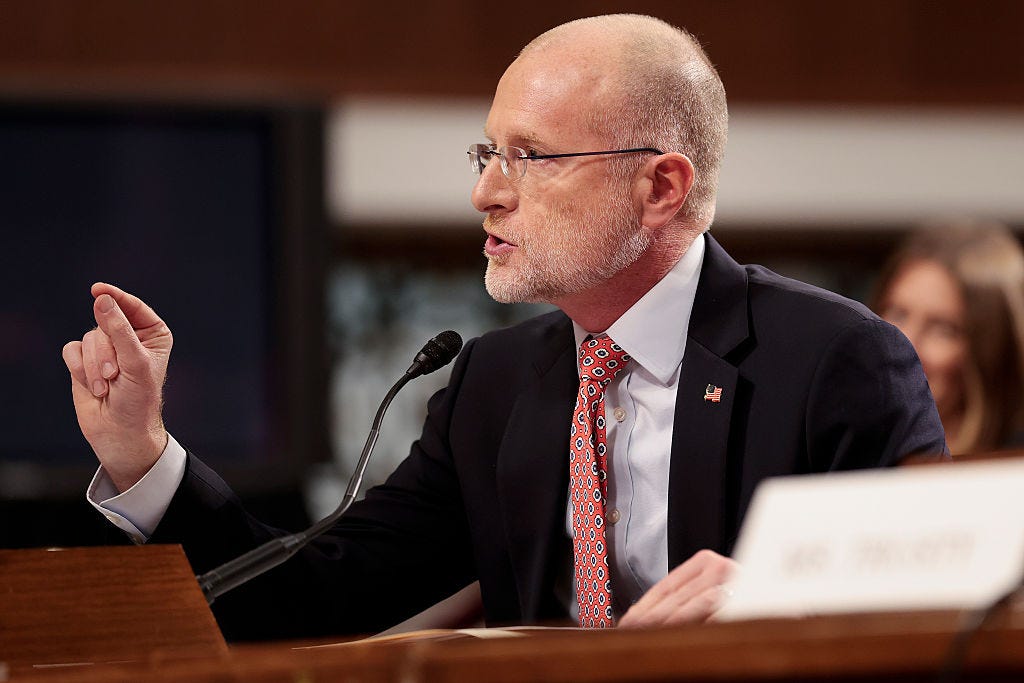
FCC Chairman Brendan Carr testified before the Senate Commerce Committee today, and I need to tell you about it. This was his first appearance before Congress since he threatened ABC back in September over Jimmy Kimmel’s late-night monologue about Charlie Kirk’s assassination. The hearing was contentious. Democrats accused Carr of turning the FCC into a censorship arm of the Trump administration. Carr, a Trump loyalist, insisted he was just doing his job.
But the wildest moment came when Sen. Ben Ray Luján asked Carr a simple question: Is the FCC an independent agency?
Carr said no. “Not an independent agency, formally speaking,” were his exact words.
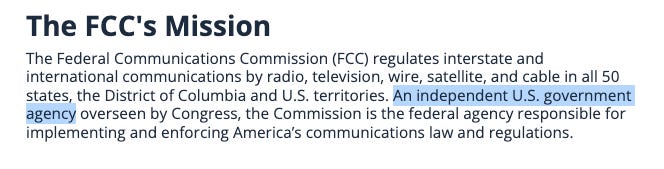
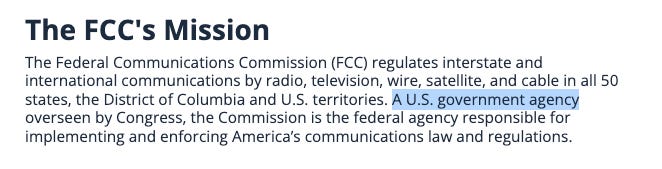
Here’s where it gets absurd. The FCC’s own website, at that very moment, described the commission as “an independent U.S. government agency overseen by Congress.” Within minutes of Carr’s answer, someone updated the website to remove the word “independent.”
Before:
After:
Sit with that for a second. A federal agency’s website was edited in real time during a congressional hearing to match what its chairman had just testified. When Sen. Luján asked Republican Commissioner Olivia Trusty whether that meant the website had been lying, she said she couldn’t speak to its contents. “I’ve not seen that,” she told him.
Democratic Commissioner Anna Gomez, the lone Democrat on the commission, had a different answer. When asked if the FCC is independent, she said yes, and added: “We should be.”
An FCC spokesperson later claimed the change was just part of routine updates “to reflect the positions of the agency’s new leadership.” Sure. What a coincidence that this particular routine update happened within minutes of Carr’s testimony. Shameful.
The Kimmel situation, explained
If you haven’t been following the Kimmel saga, here’s the background.
In September, conservative activist Charlie Kirk was assassinated while speaking at Utah Valley University. The suspect, Tyler Robinson, was a 22-year-old whose parents said he had “started to lean more left” in recent months. He reportedly told his partner he targeted Kirk because he “had enough of his hatred.”
A few days after the killing, Kimmel addressed the aftermath in his monologue. He condemned the murder and expressed condolences to Kirk’s family. He also criticized the response from Trump and his supporters, saying: “We hit some new lows over the weekend with the MAGA gang desperately trying to characterize this kid who murdered Charlie Kirk as anything other than one of them and doing everything they can to score political points from it.”

The next day, Carr went on conservative podcaster Benny Johnson’s show and called Kimmel’s remarks “some of the sickest conduct possible.” Then he issued what can only be described as a threat: “We can do this the easy way or the hard way. These companies can find ways to take action on Kimmel or there is going to be additional work for the FCC ahead.”
Within hours, Nexstar, which operates dozens of ABC affiliates and was seeking FCC approval for a $6.2 billion merger, announced it would pull Kimmel’s show. Sinclair followed. Then ABC suspended the show entirely. Trump celebrated on Truth Social, writing that it was “Great News for America” and calling for NBC to cancel Jimmy Fallon and Seth Meyers next.
The show came back about a week later after public outcry, though Sinclair and Nexstar continued to preempt it on their stations. Carr, meanwhile, cheered the affiliates for “standing up” to ABC.

The chilling effect is the point
At today’s hearing, Sen. Ed Markey brought up another case that didn’t get nearly as much national attention: KCBS, a radio station in San Francisco.
Back in January, KCBS reported on an ICE raid, describing the types of vehicles agents were driving. The station was reporting information that had been released by the mayor, a local city council member, and a community group. Standard local journalism.
Conservatives got upset. Carr accused the station of failing to operate in the public interest and opened an investigation. The station’s owner, Audacy, responded by demoting a well-regarded anchor and dialing back political coverage for months. Reporters were discouraged from pursuing political or controversial topics and encouraged to focus on human interest stories instead.
Doug Sovern, a veteran political journalist at the station, was sidelined after the investigation was announced. He retired in April. “’Chilling effect’ does not begin to describe the neutering of our political coverage,” he said.
Markey confronted Carr with this at the hearing. “The station demoted the anchor who first read that news report over the air and pulled back on its political coverage,” Markey said. “You got what you wanted.”
This is how it works. Carr doesn’t need to actually revoke anyone’s broadcast license. He just needs to threaten it. The threat is enough. Companies with billions of dollars in pending mergers that need FCC approval aren’t going to risk antagonizing the guy who can tank their deals. They’ll self-censor. They’ll punish their own journalists preemptively. The chilling effect is the point.
As Gomez put it in September, when Carr first went after Kimmel: “The threat is the point.”
Al Sikes, a Republican former FCC chairman who served under George H.W. Bush, called Carr’s approach “mobster” tactics. “What we’re seeing right now is new boundaries that are being set on the exercise of authority: punishing those that you don’t like and ensconcing those that you do.”
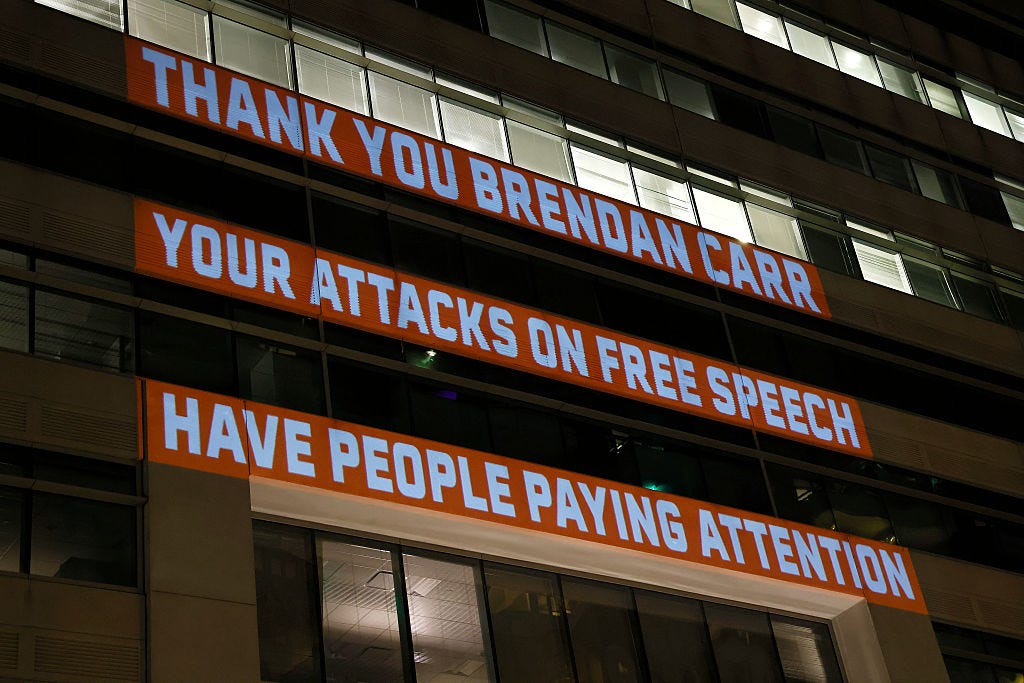
“Is Trump your boss?”
Sen. Andy Kim asked Carr directly whether he considers Trump to be his boss. Carr wouldn’t answer. He said he doesn’t “get into the specifics of conversations” he’s had.
Kim also asked if it’s appropriate for the president to use the FCC to go after critics. Carr called it a hypothetical. Kim pointed out that it’s not a hypothetical. Trump has literally posted on Truth Social calling on the FCC to take action against networks he doesn’t like.
When asked if Trump could fire him, Carr said yes.
In her opening statement, Gomez was blunt. She accused the FCC under Carr of having “undermined its reputation as a stable, independent and expert-driven regulatory body.” She said: “Nowhere is that departure more concerning than its actions to intimidate government critics, pressure media companies and challenge the boundaries of the First Amendment.”
What this means
Markey called on Carr to resign. “He is turning the Federal Communications Commission into the Federal Censorship Commission,” Markey said. “It’s a betrayal of the FCC’s mission.”
He’s right. But Carr isn’t going to resign, and Republicans aren’t going to force him out. They’re fine with this. Some of them are even saying the quiet part loud now. Carr wrote a section of Project 2025 on how to use the FCC to go after tech companies and media organizations. This isn’t some secret agenda. It’s the plan.
The FCC changing its website in real time to match Carr’s testimony is almost too on-the-nose as a metaphor. The agency is openly becoming an arm of the executive branch, used to intimidate media outlets into compliance, and they’re not even pretending otherwise anymore.
Former FCC commissioner Michael Copps, who also served under Republican administrations, said earlier this year that “Carr is the most ideological chairman we’ve ever had, and the most political.”
And what are media companies doing about it? Mostly, they’re folding. Disney suspended Kimmel. CBS settled Trump’s lawsuit against them. ABC settled too. Audacy told its reporters to lay off political coverage. The capitulation keeps happening because the threats keep working.
I don't know that I've ever seen a change like that in real time to the text of an official government website. It's absurd, and yet it's not surprising for this administration.
Of course, Brendan Carr can say the FCC isn't independent, and online text can follow suit, but Anna Gomez and others who vow that it should be independent are in the right. Until leadership changes, however, we'll need to put up with the farce that the agency as a whole is acting with legitimacy.
I think the change was related to the recent SCOTUS decision that eliminated the Democrat dream of unelected bureaucrats that can never be fired even if found to be connected to Soros or the CCP or the Democrat command center (all related). I like the FTC being under the Administration so we can fire the leadership if they suck, and elect a new administration if they direct the FTC leadership to suck. Note that the FTC generally lacks teeth unless supported by the antitrust arm of the DOJ.