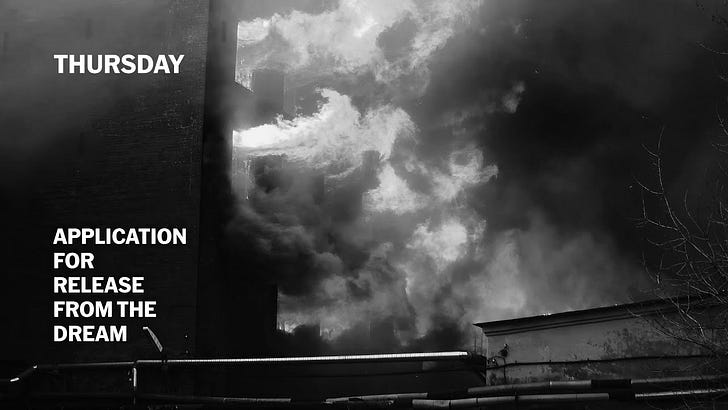

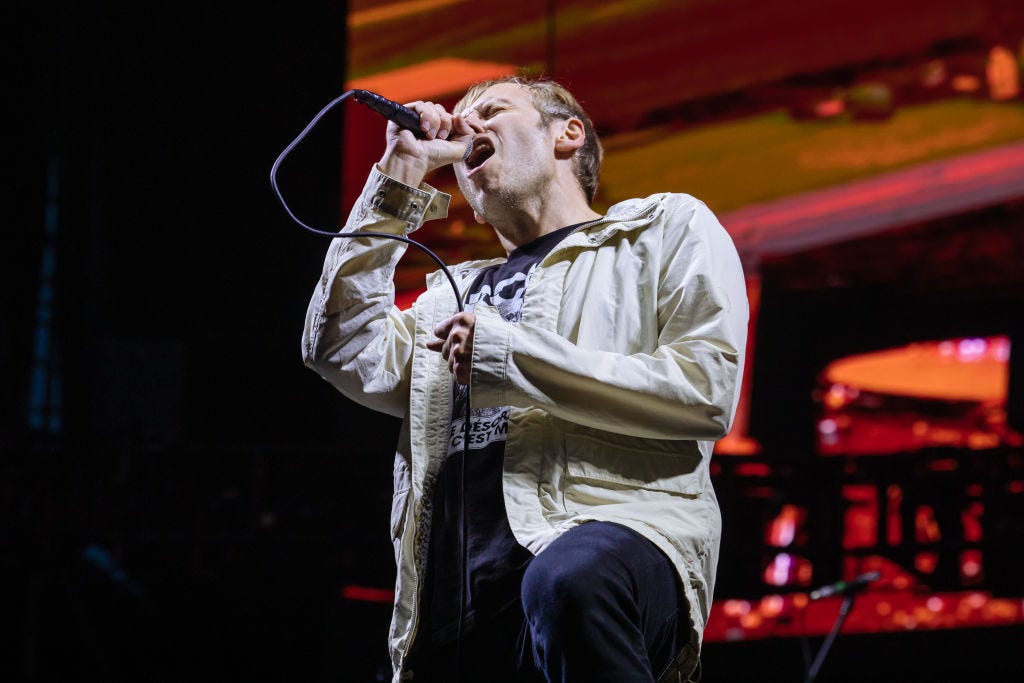
I interviewed Geoffrey Rickly recently for this newsletter. Geoff is the singer of Thursday, a band that came out of the New Jersey hardcore scene in the late ‘90s and helped define what rock music sounded like in the early 2000s. (If you’ve heard of My Chemical Romance, Geoff produced their first album.) I’ve been a fan since high school. We’ve been in touch for several years, and I’ve been looking for an excuse to interview him for something.
We covered a lot of ground. His novel. His new Substack. What it’s like to play songs that are now older than you were when you wrote them. But the thing that stuck with me was his answer when I asked about the infrastructure that used to exist around music. Pitchfork, MTV, the music magazines, the labels that could actually put a new band in front of an audience. He compared musicians to canaries in a coal mine. The stuff everybody wants, the stuff that got monetized early, that’s what gets hit first when the economics shift. “They’ll go first,” he said.
And then: “Some of the stuff that we’re seeing in media, and especially legacy media, we already went down this road a decade or more ago with music.”
I think he’s right. And I think the version of this that’s coming for news is worse.
Here’s what’s left
In January 2024, Condé Nast merged Pitchfork into GQ. Editor-in-chief Puja Patel was let go, along with most of the editorial staff. Anna Wintour delivered the news wearing sunglasses. Andy Cush, one of the writers who lost his job, told The Needle Drop there was “this real sense of despair about ever having a place to do the kind of work you feel like you’re good at.” At the time, Pitchfork had the most daily active users of any Condé Nast publication. It wasn’t absorbed because nobody was reading it.
In November 2025, Stereogum paywalled its content. Its editor explained the decision in a piece titled “Getting Killed by AI.” Two months later, in January 2026, Pitchfork followed, launching a $5-a-month subscription and limiting non-subscribers to a handful of reviews a month.
That’s the infrastructure Geoff was talking about. Or what’s left of it. The system that used to find new music and explain it to people is either dead or behind a paywall. Sure, there are still influencers, but it’s less centralized and more scattershot. So what happens to the people who depended on the old ways?
So what do you do?
Geoff saw it coming early. When Thursday released War All the Time, their major label debut on Island Records, in 2003, it hit the Billboard Top 10 in its first week, selling around 80,000 copies. But the label had done something unusual: they hosted the illegal downloads themselves, just to measure what they were losing. On day one, there were 325,000. The label told him he probably would have charted at number one or two if all those downloads had been sales. “I don’t think that everybody who downloads our record is going to buy it,” he told me. “I just was like, well, that’s a pretty huge change.” He could see the graphs going in opposite directions. The label told him his audience would get hit first. “Country won’t be hit for another six, seven years” was the attitude. That was 2003.
If you’re Geoff, you adapt. “I’ve always admired bands like Fugazi,” he said, “but I’ve always been much more pragmatic. I just see what’s going to work.” He’s put out records on everything from small indies to major labels, ran his own label, published a novel (Someone Who Isn’t Me, a hallucinatory autofiction about heroin addiction that got serious literary attention in 2023). And most recently, he started a Substack called Solo Record, where he’s writing personal essays, serializing short fiction about life on tour, and posting demos.

His solo record isn’t music. It’s writing.
How he got to Substack is its own story. He’d been posting on Instagram about who writes the best sex scenes (research for his second novel), it went viral, Vice offered to run a column, but he decided to just do it himself. “My most successful endeavors in life have been kind of DIY,” he said. “Not doing it for a bigger platform.”
He’s not the only musician who’s ended up here. Patti Smith is on Substack. Jeff Tweedy has over 146,000 subscribers. Charli xcx, Tegan and Sara, Neko Case. When I asked Geoff why so many artists were migrating to a platform originally built for journalists and newsletter writers, he was blunt: “Giving it away on X or Instagram just feels so compromised. Like, I can’t believe I’m giving this corporation content.” He acknowledged that Substack has its own problems (”I know that Substack has gotten a lot of flack recently, and probably rightly so”), but said the environment just feels different from everywhere else.
There’s an irony here. The collapse hit music a decade before it hit news. But journalists found this particular lifeboat, as tenuous as it is, first. I started my own newsletter five years ago, back when it was mostly writers who’d been laid off, trying to build something after the institutions they’d worked for disappeared. And now here are the musicians, a decade after their own industry fell apart, landing in the same place for the same reasons. The destination is the same. The wreckage that sent them there just happened on different timelines.
But here’s what nags at me. When every artist is their own media operation, nobody is doing the work that Pitchfork, for all its problems, used to do. Nobody is telling you what’s worth your time and making a case for why. The curation is gone. The criticism is gone. What’s left is direct-to-audience communication, which is great if you already have an audience and invisible if you don’t.
I asked Geoff about that. About the bands who are where Thursday was 25 years ago, five kids with no following and no connections. “I often think about what the bands today that would love to be in a similar position, what’s their path these days?” he said. “And I think it’s just really different.”
And then there’s news
Geoff doesn’t worry that much about the collapse of music media. He thinks people will keep finding ways to share opinions on music, and that the best writers will find audiences. What worries him is what’s happening to news.
“I have anxiety about the news, newspapers in general,” he told me. “I think there’s such a motive to be able to manipulate that and to paint everything in a propagandistic way rather than a fact-based way.”
This is a guy who has spent 25 years inside the collapse. And when he looks at what’s happening to news media, his reaction is: that’s worse.
He’s not wrong. Local newspapers are shutting down. The ones that survive are being bought by corporations with obvious political interests. The same people buying up CBS and CNN also control TikTok. And the music industry’s version of this collapse produced a world where every artist has a platform and nobody has an editor. The news industry’s version is producing a world where every politician has a newsletter and nobody has a reporter. The first one means you might miss a good band. The second one means something else entirely.
Toward the end of our conversation, I asked Geoff about Thursday’s upcoming tour. They’re playing (most of) Full Collapse. The album turns 25 next month. I asked him if it was weird that the record is now older than he was when he made it.
“Wow,” he said. “I hadn’t really grappled with that yet.”
“When you’re young, you don’t realize that when you get older, you don’t really feel different.”
That’s the thing about collapse, too. It doesn’t feel like a dramatic event from the inside. It’s a slow accumulation of things that used to work and don’t anymore, until one day you’re 47, writing a newsletter on a platform full of journalists, because the system that was built for you no longer exists. And you don’t really feel different. You just are.