
They Faked Her Tears
The administration's response to getting caught digitally altering an image of a civil rights attorney: "The memes will continue."

On Thursday morning, Homeland Security Secretary Kristi Noem posted a photo to X of Nekima Levy Armstrong being led away in handcuffs. Armstrong, a civil rights attorney and former president of the Minneapolis NAACP, had just been arrested for her role in organizing a protest at a St. Paul church earlier this week. In the photo, her face is calm. Neutral.
About thirty minutes later, the official White House account posted what appeared to be the same image. Same angle, same moment, same handcuffs. But in this version, Armstrong is sobbing. Her face is contorted. Tears stream down her cheeks.
The second photo is fake.
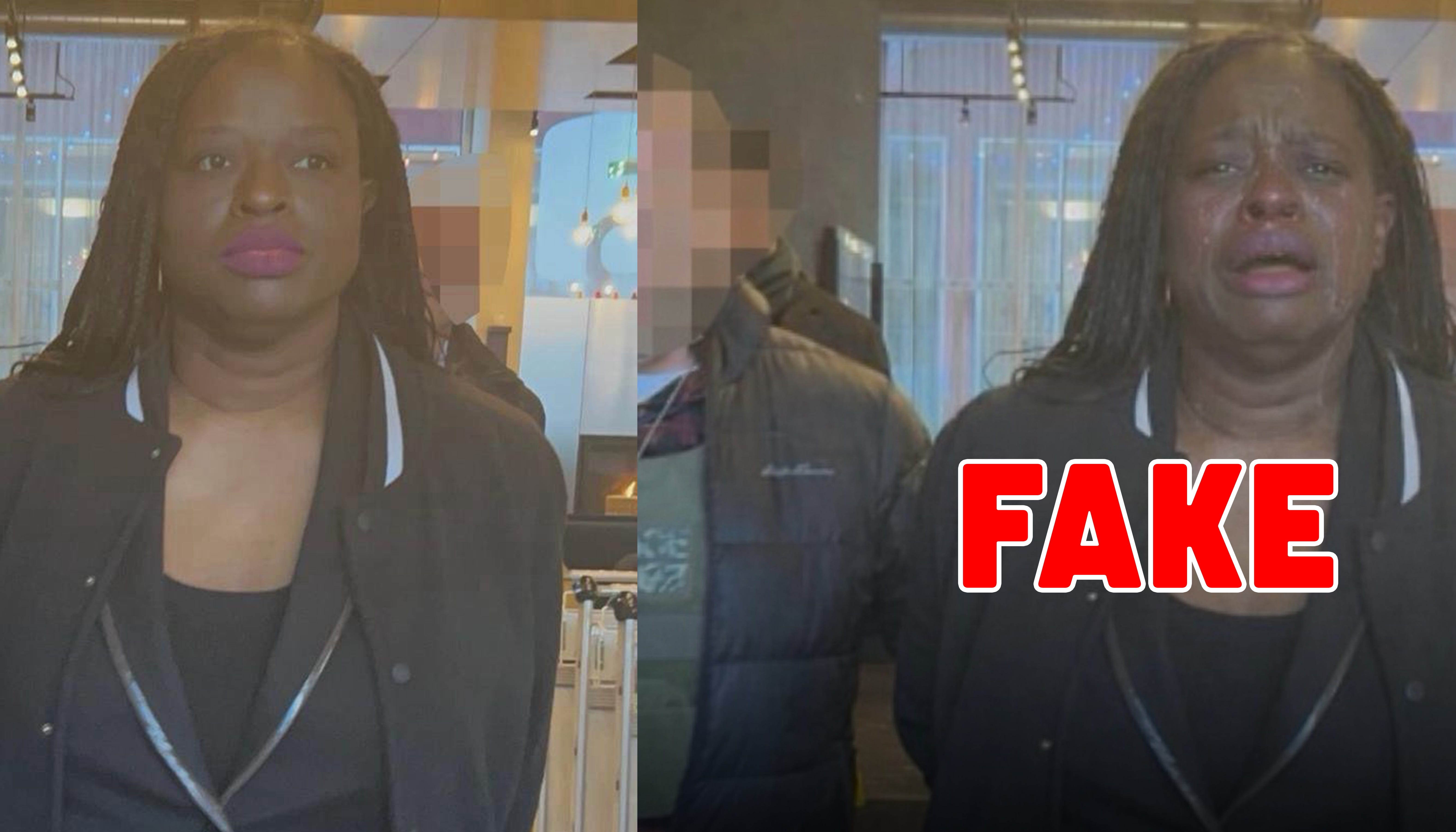
The White House digitally altered the image of Armstrong’s arrest to manufacture the appearance of emotional breakdown. There was no disclosure, no indication the photo had been manipulated. It was posted as though it were real, with a caption labeling Armstrong a “far-left agitator.” Vice President JD Vance amplified it to his own followers.
Armstrong’s attorney, Jordan Kushner, told the Associated Press that he was present at her arrest. “She was completely calm and composed and rational,” he said. “There was no one crying. So this is just outrageous defamation.”
Getting caught fabricating government propaganda used to have consequences. Embarrassment, at minimum. A retraction, maybe. Some attempt to explain it away.
That’s not what happened here.
When CBS News asked the White House whether the photo had been altered, the press office responded by sending a link to an X post from White House Deputy Communications Director Kaelan Dorr. His statement, in full: “YET AGAIN to the people who feel the need to reflexively defend perpetrators of heinous crimes in our country I share with you this message: Enforcement of the law will continue. The memes will continue. Thank you for your attention to this matter.”
The memes will continue.
Hany Farid, a digital forensics expert at UC Berkeley who has spent decades studying image manipulation, told CBS News that the image was likely altered using AI. “This is not the first time that the White House has shared AI-manipulated or AI-generated content,” he said. “This trend is troubling on several levels. Not only are they sharing deceptive content, they are making it increasingly more difficult for the public to trust anything they share with us.”
Armstrong was arrested for organizing a protest at Cities Church in St. Paul, where one of the pastors, David Easterwood, reportedly serves as an official in the local ICE field office. That protest happened in the wake of ICE agent Jonathan Ross killing Renee Good, a 37-year-old U.S. citizen and mother of three, on January 7th. Good had just dropped her six-year-old son off at school. The administration claimed she tried to “weaponize her vehicle” against officers.
The charge they’re using against Armstrong? A federal conspiracy statute from the Reconstruction era. The same law that was used to charge Donald Trump for his efforts to overturn the 2020 election. They are now using it against a Black civil rights attorney who organized a protest over ICE killing a U.S. citizen.
And then they doctored her arrest photo to make her look like she was crying.
This is what a year of normalization looks like
The Armstrong photo didn’t emerge from nowhere. It’s the latest entry in what has become a defining feature of the second Trump administration: the systematic deployment of AI-generated and digitally manipulated content as official government communication.
NBC News reviewed Trump’s Truth Social account last fall and found dozens of pieces of synthetic media posted since he returned to the White House in January 2025. About half of those posts came in just August and September. The pace has only accelerated since.
In the early months, the AI content was mostly self-aggrandizing. Trump standing next to a roaring lion. Trump conducting an orchestra at the Kennedy Center. The official White House X account posting AI portraits of Trump as a king and as Superman. Embarrassing? Sure. A 79-year-old man using government resources to post fan art of himself.


Then came the attacks on political opponents. A deepfake of Nancy Pelosi depicting her confessing to a crime. Chuck Schumer in a cartoon sombrero. During the government shutdown last fall, Trump posted a video depicting Office of Management and Budget Director Russ Vought as the Grim Reaper as the administration threatened mass layoffs of federal workers.
These were political figures. Public officials. People who signed up for political combat. You could squint and call it satire, if you were feeling generous.
The Armstrong image is something different.
Nekima Levy Armstrong is a private citizen. Yes, she’s a public figure in Minneapolis. Yes, she organized a protest. But she is not a politician, not a government official, not someone who sought out the arena of national political combat. She’s a civil rights attorney who has spent years advocating for her community. The government arrested her, and then the government fabricated an image to humiliate her.
This is the trajectory: from self-glorification, to attacking political enemies, to targeting individual citizens.
University of Southern California associate professor of communications and journalism Mike Ananny told The Independent that the brazenness of the response signals something has fundamentally shifted. Getting caught using doctored images used to end careers and derail campaigns. “There’s no sense of, ‘Oh no, we were caught using a synthetically generated image,’” Ananny said. “All gloves are off. People don’t seem to care.”
The White House has been explicit about this. “Nowhere in the Constitution does it say we can’t post banger memes,” the official White House X account declared last July. Press Secretary Karoline Leavitt has defended the president’s habit of posting manipulated content as evidence of his transparency. “He likes to share memes. He likes to share videos,” she said during a briefing last fall. “I think it’s quite refreshing.”
Refreshing. That’s one word for the U.S. government fabricating propaganda about its own citizens.
Here’s what makes the “meme” framing so effective as a shield: it makes the critic sound like they’re overreacting. It’s just a joke. It’s just the internet. Why are you taking this so seriously? This rhetorical move transforms anyone who objects into the real problem. You’re not concerned about state-produced disinformation; you’re a humorless scold who doesn’t understand internet culture.
But the people running the White House communications operation understand exactly what they’re doing. As Valerie Wirtschafter, a fellow at the Brookings Institution who studies AI in politics, told NBC News: “They go viral. They get attention. They’re this meme-ification of politics. They’re a little odd. But they get shared. They get eyeballs.”
The eyeballs on the fabricated image of Armstrong crying aren’t seeing a meme. They’re seeing what looks like a real photograph of a real arrest, posted by the official account of the White House of the United States, with no indication it was altered. Many of them will never see the correction. They’ll just remember the crying woman in handcuffs.
That’s the point.
The killing they’d rather you forget
The White House would very much like you to focus on the fake tears. What they don’t want you thinking about is why Nekima Levy Armstrong was protesting in the first place.
On January 7th, ICE agent Jonathan Ross shot and killed Renee Good, a 37-year-old U.S. citizen, on a residential street in Minneapolis. The administration claimed self-defense. Video of the shooting told a different story. Minneapolis Mayor Jacob Frey reviewed the footage and called the administration’s account “bullshit.” Minnesota Governor Tim Walz proclaimed January 9th “Renee Good Day.”
The Department of Justice response: Deputy Attorney General Todd Blanche announced there is “currently no basis for a criminal civil rights investigation” into the officer’s conduct. At least six federal prosecutors in Minnesota resigned in protest. The Civil Rights Division was told it would not be part of the investigation.
Less than two weeks later, the same Justice Department announced it was arresting the people who protested that killing.
Armstrong was charged under 18 U.S.C. § 241, a Reconstruction-era statute originally written to prosecute the Ku Klux Klan for conspiring to violate the civil rights of Black Americans. The administration also tried to charge journalist Don Lemon, who was present and livestreaming. A magistrate judge refused to sign the complaint. According to CBS News, the judge physically crossed off one of the charges on another protester’s arrest warrant and wrote “NO PROBABLE CAUSE” in the margin.
Vice President JD Vance, speaking from Toledo before heading to Minnesota, put it plainly: “Those people are going to be sent to prison so long as we have the power to do so.”
This is the context the fabricated photograph is designed to obscure. The administration killed a U.S. citizen and refused to investigate. People protested. The administration arrested the protesters and charged them under an anti-Klan law. And then the White House doctored a photo of one of those protesters to make her look like she was crying.
The composed Black woman in the real image is inconvenient. She doesn’t look defeated. She doesn’t look broken. She looks like exactly what she is: a civil rights attorney who knew what she was doing and why. So they fixed that.
When anything can be fake, nothing has to be real
There’s a concept that researchers who study disinformation have been warning about for years. They call it the “liar’s dividend.”
The idea comes from a 2018 paper by law professors Danielle Citron and Robert Chesney. As they put it: “A skeptical public will be primed to doubt the authenticity of real audio and video evidence.” The liar’s dividend is what happens when the mere existence of sophisticated fakes gives bad actors cover to dismiss anything inconvenient as fabricated.
Hany Farid, the UC Berkeley professor who analyzed the Armstrong photo for CBS News, has spent years warning about exactly this dynamic. “That’s exactly what we were concerned about: that when we entered this age of deepfakes, anybody can deny reality,” he told NPR. “That is the classic liar’s dividend.”
We’ve already seen Trump use this playbook. Last fall, when a real video surfaced showing something being thrown from an upper-story White House window, the president dismissed it: “No, that’s probably AI.” His press team had already confirmed to reporters that the video was authentic. Didn’t matter.
The liar’s dividend usually works as a shield: deny the real, claim it’s fake. The Armstrong photo is a weapon. The government manufactured a reality that never existed. And there is essentially nothing stopping them from doing it to anyone.
Trump signed the Take It Down Act last year, which criminalizes nonconsensual intimate imagery. It does not cover the government fabricating tears on an arrest photo. It does not cover deepfakes designed to humiliate political opponents. It does not cover the official White House account posting manipulated images of private citizens to millions of followers with no disclosure that the content was altered.
As NOTUS reported, “there are currently no federal laws regulating the creation and dissemination of nonconsensual digitally altered images in general.” The White House can do this to anyone. They can fabricate evidence of emotional breakdown, physical distress, criminal behavior. They can post it to an audience of millions. And when caught, they can call it a meme.
There are no guardrails. The government will keep producing fabricated content about its perceived enemies. Getting caught changes nothing.
The usual advice for navigating a world of deepfakes is to teach people how to spot manipulated content. Look for inconsistencies. Check for weird artifacts. Cross-reference with other sources. This advice is fine as far as it goes. But as I wrote last fall, it misses the larger problem: people don’t want to spot the difference when the fake confirms what they already believe, or when calling something fake protects someone they support.
The people who saw the fabricated image of Armstrong crying are not, for the most part, going to go find Kristi Noem’s original post and compare the two. They’re going to see a Black woman civil rights attorney sobbing in handcuffs, posted by the official White House account, and that’s the image that will stick. Mission accomplished.
And the next time there’s a real photo of something the administration doesn’t like? They can just say it’s AI. They’ve already established that they traffic in manipulated images all the time. They’ve poisoned the well of their own credibility, and in doing so, they’ve made it easier to deny anything.
Libby Lange, an analyst at the misinformation-tracking organization Graphika, put it this way in a 2024 interview with the Washington Post: “If everything could be fake, and if everyone’s claiming everything is fake or manipulated in some way, there’s really no sense of ground truth. Politically motivated actors, especially, can take whatever interpretation they choose.”
That’s the world we’re in now. The U.S. government is actively contributing to the erosion of shared reality, and when confronted about it, they laugh.
For those who would like to financially support The Present Age on a non-Substack platform, please be aware that I also publish these pieces to my Patreon.
What they want you to forget
Nekima Levy Armstrong was released Thursday after a magistrate judge rejected the government’s request for a detention hearing. She will face federal charges under a Reconstruction-era civil rights statute for organizing a protest at a church. The White House’s fabricated image of her sobbing remains online.
Her attorney, Jordan Kushner, said video taken by Armstrong’s husband would be released soon. The footage, he said, “dismantles what they claim.”
Defamation, in the traditional sense, requires a false statement of fact that damages someone’s reputation. It requires the person making the statement to know it was false, or to act with reckless disregard for the truth. It typically requires the target to prove damages.
What do you do when the defamer is the federal government? When the false statement is an image, not words? When the damage is done before anyone notices the fake? When millions of people have already seen it, already formed their impression, already moved on?
What do you do when they tell you, openly, that they’re going to keep doing it?
Authoritarian governments have always understood the power of images. They airbrush dissidents out of photographs. They fabricate evidence. They manufacture the visual record to match the story they want to tell. The physical archive of the 20th century is littered with doctored photos from regimes that understood you could reshape reality if you controlled what people saw.
The difference now is speed. It took the White House thirty minutes to transform a composed Black woman into a sobbing wreck. It took no specialized skills, no darkroom, no elaborate conspiracy. Just someone with access to the official account and a willingness to press the button.
And when confronted, they didn’t deny it. They didn’t apologize. They didn’t even pretend to be embarrassed. They promised to do it again.
The people in charge don’t care. The question is whether anyone else will.
Pay attention to how this story gets covered in the coming days. Watch whether outlets frame this as “White House posts altered image” or “White House fabricates propaganda image of arrested citizen.” Watch whether it gets treated as a curiosity, a footnote, a one-day story that fades into the flood of everything else.
The disgusting racists also made her skin darker. There is no bottom with these people.
“All gloves are off. People don’t seem to care.”
I guess I will always push back against this sort of claim. People do care, normal people care, the people who don't care - and even celebrate this shit - are Tubby's superfans, a shrinking portion of the population if his approval rating is any indication.
I get it, a monster like Trump harms many things, and one of the things he harms is our opinion of our fellow humans. We all carry around a notion of how good or awful humans are, on average, and it's hard for that not to take a hit when you see tens of millions of people enthusiastically joining in the performative cruelty.
But think of the people who don't get all the attention, the decent people who go through their day caring for others, because there are out there, by the billions.